
Hurricane-season lawn and yard prep for Southwest Florida
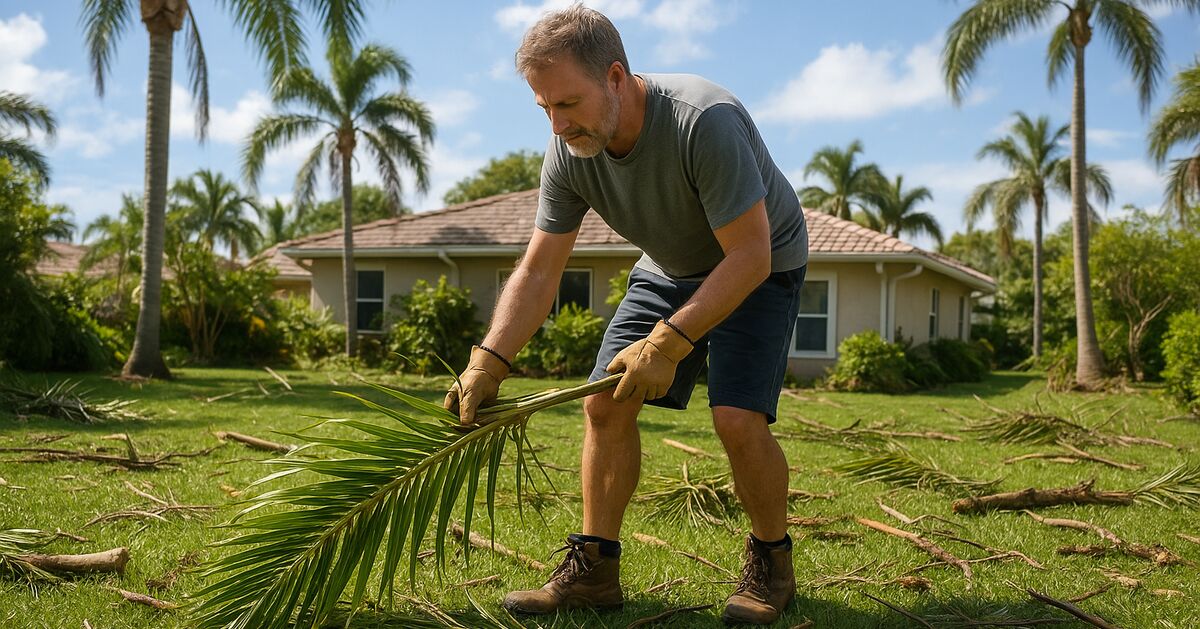
Florida's hurricane season runs from June 1 through November 30, and if you've lived anywhere near Bradenton, Parrish, or Anna Maria Island for more than one season, you already know how fast the Gulf can change its mind. One week you're mowing in sunshine; the next, a named storm is angling toward Manatee County. The homeowners who come through hurricane season with the least lawn damage aren't the ones who got lucky with the storm track. They're the ones who did the boring, unglamorous prep work in the weeks before.
This guide walks through both sides of the equation: what to do before a storm arrives, and how to handle your yard in the days and weeks after it passes. We'll cover grass, trees, shrubs, mulch, irrigation, and the recovery mistakes that set people back further than the storm itself.
Why your yard is more than just scenery during a storm
It's easy to think of lawn prep as a low priority compared to boarding windows or stocking supplies. But your yard is full of potential projectiles and flood contributors. An unsecured clay pot, a poorly anchored landscape timber, a dead limb hanging over the roofline, a clogged french drain, all of these become real hazards once wind speeds climb past 50 mph.
Beyond safety, your landscape is also a significant financial investment. Mature trees, established St. Augustine turf, and healthy shrubs take years to grow. A little focused prep before the storm can be the difference between a yard that bounces back in two weeks and one that needs a near-complete renovation.
Our lawn care and landscaping services are designed with Southwest Florida's conditions in mind, and that includes helping homeowners get their properties storm-ready during the peak of hurricane season.
Pre-storm prep: the yard walkthrough you should do now
Step 1: Walk the perimeter with fresh eyes
Do this at least 48 to 72 hours before a storm is expected, not the morning it's arriving. Look for:
- Dead or cracked branches on oaks, maples, and especially older palms. Any branch that's already partially detached or visibly rotted is going to come down in a storm. Remove it now, on your schedule, not at 70 mph.
- Leaning trees or shallow root plates. If a large tree has been leaning more than usual after recent rains, or if you can see roots lifting on the windward side, flag it for a professional to evaluate before the season peaks.
- Loose or stacked items. Landscape stones, ceramic pots, bird baths, decorative boulders, wooden furniture, trellises, and children's play equipment all need to come in or be anchored. Even a small clay pot at 60 mph becomes a projectile.
- Mulch depth. Thick, loose mulch near the house can become debris and it can also dam water against your foundation. We'll talk more about mulch in the recovery section below.
Step 2: Trim, but don't over-trim
One of the most common mistakes homeowners make before hurricane season is going overboard with tree trimming right before a storm. Aggressive pruning removes the foliage that helps a tree flex and absorb wind. The goal is to remove dead, diseased, or crossing branches, not to "thin" the canopy so dramatically that you expose more inner branches to wind load.
For palms specifically, the advice has evolved. The old practice of cutting fronds back to a tight "hurricane cut" (leaving only the top few green fronds) is now widely discouraged by arborists because it stresses the palm, slows recovery, and can invite pests and disease. Leave healthy green fronds in place. Remove only the truly dead, brown fronds hanging below the canopy.
Timing matters too. Manatee County and the surrounding municipalities have their own guidelines about debris pickup schedules before storms. If you trim too late, you may be leaving a pile of branches at the curb that becomes airborne in the storm. Trim early enough that debris can be hauled before the cone closes in.
Step 3: Mow slightly lower than usual, but not short
In the days before a storm, mow your lawn at a slightly reduced height, maybe half an inch lower than your regular setting. This isn't scalping, which we know is harmful, but bringing the turf down a notch reduces the amount of leaf blade that can get torn or matted down under standing water and debris. For St. Augustine, that still means staying at or above 3.5 inches. For Bahia, 3 inches is a reasonable floor.
Matted turf under prolonged standing water becomes a breeding ground for gray leaf spot and other fungal diseases that surge after tropical rainfall. Slightly shorter turf dries faster and gives you a head start on recovery.
Step 4: Check your drainage before the rain arrives
A storm dropping 8 to 15 inches of rain on a yard that already has drainage problems is a recipe for turf loss, foundation seepage, and a very long recovery. Walk your yard after the next ordinary afternoon thunderstorm and note where water stands for more than 30 to 45 minutes. Those are your trouble spots.
Clear debris from any swales, culverts, or drainage inlets on or near your property. If your yard has chronic low spots that pond after normal rain, a hurricane could mean days of standing water rather than hours. We've written in depth about fixing lawn drainage after Florida downpours, and the same principles apply here at a larger scale.
Homeowners in low-lying areas of Ellenton, parts of Parrish, and the older neighborhoods of Palmetto tend to see the worst post-storm ponding. If you're in one of those zones, drainage prep is not optional.
Step 5: Secure or store irrigation components
Pop-up sprinkler heads are surprisingly fragile under storm surge and heavy debris load. If you have any above-ground irrigation components, controllers mounted on exterior walls, or drip lines staked into beds, do your best to protect or disconnect them. After the storm, check the entire system before re-enabling it. A broken head left running can waste thousands of gallons and create saturated conditions that invite root rot and pest pressure.
Step 6: Pull potted plants and container gardens inside
This bears repeating because it's the one step most homeowners skip until it's too late. Every container, pot, planter box, or hanging basket in your yard is a potential projectile. A 20-pound ceramic planter becomes genuinely dangerous at hurricane-force wind speeds. Move them all into a garage, shed, or interior space before the storm.
After the storm: the recovery sequence that protects your lawn
The first 24 to 48 hours after a hurricane passes are critical. Your instinct may be to get outside and start cleaning up immediately, but the order in which you do things matters as much as the doing.
Safety first, then assessment
Do not walk your property while wind gusts are still present, even after the eye passes if you're in a double-eyewall storm. Look for downed power lines before stepping into any standing water. Once it's clearly safe, do a full property walkthrough and take photos of every area of damage for insurance purposes before you move anything.
Remove debris without tearing up turf
Heavy branches sitting on turf for more than a day or two will kill the grass beneath them. Remove debris promptly, but drag or lift items rather than dragging them in ways that tear the sod. If you have a large branch that fell and embedded itself in the lawn, cut it into sections and lift, rather than dragging the whole thing across 30 feet of turf.
Do not mow wet, matted turf
Mowing saturated lawn is one of the most damaging things you can do after a storm. Wet mowing compacts the soil, tears rather than cuts the blades, spreads fungal spores across the yard, and leaves ruts from mower wheels. Wait until the yard has drained and the turf has had at least one dry day before mowing again.
Flush salt-affected areas if storm surge reached your property
Homeowners near the waterfront in Anna Maria Island, along the Manatee River, or in coastal Palmetto need to pay special attention to salt exposure. Storm surge carries salt water well inland, and St. Augustine grass is moderately sensitive to salinity. If surge reached your turf, water the area heavily and repeatedly with fresh water in the days following the storm to dilute and flush salt from the root zone. Do this before applying any fertilizer or treatments.
Watch for the fungal surge that follows every hurricane
The combination of standing water, heat, high humidity, and damaged turf is a perfect setup for fungal disease. Take-all root rot is especially common in the weeks following a major storm, showing up as irregular bare patches that seem to spread even after the yard dries out. Similarly, gray leaf spot can explode across St. Augustine lawns when wet conditions linger.
If you see brown or tan lesions appearing on leaf blades within 1 to 2 weeks of the storm, that's likely gray leaf spot. If you see bare patches expanding and the roots in those areas look brown and rotted rather than white and healthy, that's a sign of root-level disease. In either case, don't fertilize in an attempt to push growth. Nitrogen on stressed, diseased turf almost always makes things worse.
Hold off on fertilizing
This is the rule most homeowners break in the weeks after a storm because their lawn looks bad and they want to fix it fast. Fertilizing storm-damaged turf before it has had time to stabilize invites more disease, can burn weakened root systems, and wastes product that will simply wash away if rain returns. Wait until the turf is actively growing again and conditions have normalized, typically 3 to 4 weeks post-storm at minimum.
Manatee County's fertilizer blackout periods also apply here. Fertilizing during the restricted summer/rainy season window isn't just bad for your lawn, it's against local ordinance.
Replant bare patches carefully
Once the turf has stabilized and you have 2 to 3 weeks of normal growing conditions ahead, bare patches can be addressed. Match your existing grass type exactly. Plugging St. Augustine into a Bahia lawn or vice versa creates an uneven, hard-to-manage mess. If you're uncertain what variety you have, reach out to us and we can help you identify it before you buy sod.
Check for secondary pest pressure
Storm damage to turf creates exactly the vulnerable conditions that pests like mole crickets prefer. Thinned, stressed turf with loose, wet soil is easy to tunnel through. Similarly, sod webworms can take hold rapidly in a lawn already weakened by storm stress. Check for tunneling activity, frass, and moth activity in the evenings a week or two after a storm passes.
What professional lawn care looks like during hurricane season
A lot of the prep and recovery work described above is DIY-friendly. But some of it genuinely benefits from a professional eye: tree risk assessment, drainage evaluation, disease identification, and turf renovation all involve judgment calls that experience sharpens considerably.
We work throughout Bradenton, Lakewood Ranch, Parrish, and across our full service area year-round, and that includes pre-storm site checks and post-storm cleanup and recovery. If you're heading into hurricane season uncertain about a leaning tree, a low spot in your yard, or the health of your turf, a quick professional walkthrough is worth the time.
A simple pre-storm checklist
To make the above concrete and actionable, here's a condensed version you can work through before the next storm:
- Walk the perimeter and remove or anchor all loose items
- Trim dead branches (but not healthy canopy)
- Mow slightly lower than usual, stay above 3.5 inches for St. Augustine
- Clear swales, drainage inlets, and obvious low spots
- Protect or disconnect irrigation components
- Move all containers and pots indoors
- Check in with neighbors about shared trees near property lines
- Take photos of your yard's current condition for insurance reference
And after the storm:
- Wait for all clear before entering yard
- Photograph all damage before moving anything
- Remove debris by lifting, not dragging
- Do not mow wet turf
- Flush coastal areas with fresh water if surge reached them
- Monitor for fungal disease
- Hold fertilizer for 3 to 4 weeks
- Watch for mole cricket and sod webworm activity
Hurricane season in Southwest Florida is long, and storms can arrive any time within that six-month window. Getting into good habits early, doing the walkthrough now rather than when a cone is sitting over Tampa Bay, is the approach that protects both your safety and your landscape investment.
If you have questions about specific trees, drainage concerns, or what your yard needs heading into storm season, our FAQ page covers a lot of common scenarios, and we're always happy to talk through what's specific to your property.