
Standing water after a Florida downpour? How to fix lawn
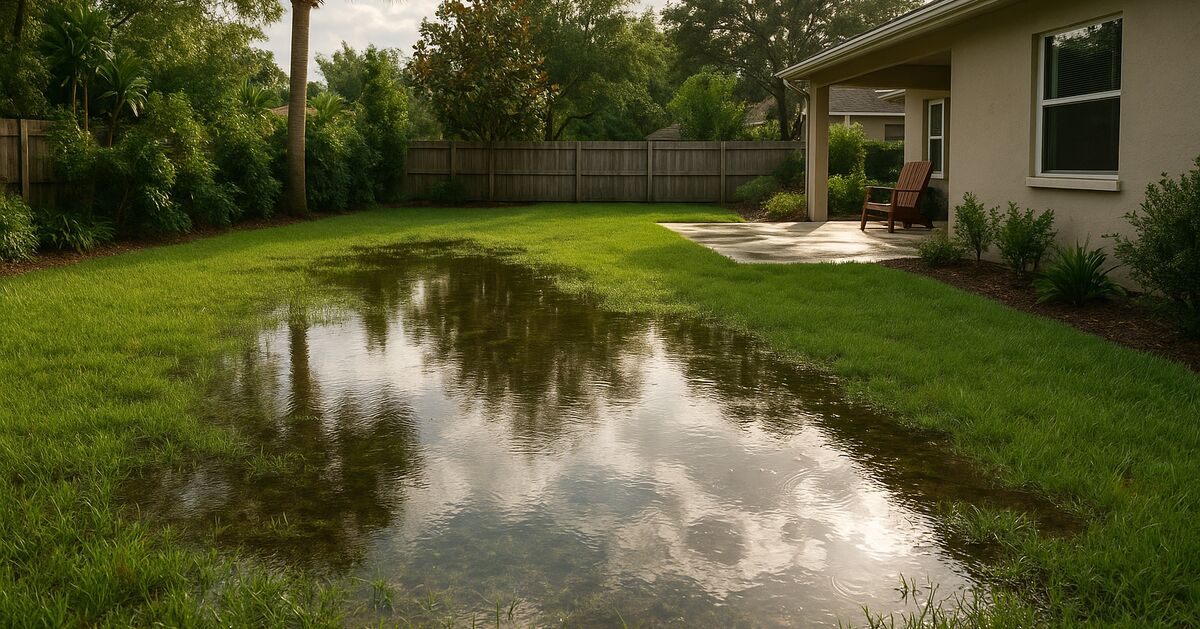
A summer thunderstorm drops two inches of rain on your Bradenton yard in forty minutes, and by the time the last rumble fades you're staring at a shallow lake where your lawn used to be. If that scene sounds familiar, you're not imagining things. Drainage problems are one of the most common calls we get across our Southwest Florida service area, and they're not just an eyesore. Persistent ponding drowns grass roots, invites fungal disease, breeds mosquitoes, and can threaten your home's foundation if the water pools close enough to the slab. The good news is that most drainage problems are fixable once you understand why they happen.
Why flat Florida yards pond so easily
Florida's topography is the first part of the puzzle. Manatee County sits at an average elevation of just a few feet above sea level, and most neighborhoods, whether in Lakewood Ranch, Parrish, Ellenton, or Palmetto, were built on land that was essentially flat to begin with. Developers typically rough-grade a site before laying sod, but over years of foot traffic, settling soil, and shifting tree roots, that original grade gets bumped and dimpled until water has nowhere to go.
The second issue is the soil itself. Much of coastal Manatee County sits on a base of sandy fill over clay-heavy subsoil. Sandy topsoil drains quickly, but when a summer storm delivers a true Florida downpour, the sandy layer saturates in minutes and the underlying clay acts like a bathtub liner. Water simply cannot move downward fast enough, so it spreads out across the surface instead.
The third factor is impervious surface. Driveways, patios, pool decks, and walkways shed water directly onto adjacent turf. If your yard has a lot of hardscape, your lawn is absorbing runoff from both the sky and the surrounding concrete, which multiplies the load considerably.
Finally, the water table in this region is already close to the surface for much of the rainy season. From late May through September, the aquifer is essentially topped off. There is very little room beneath your feet to absorb anything extra, which means surface runoff stays on top much longer than it would in, say, the Georgia foothills.
How to diagnose your specific drainage problem
Before you call anyone or rent a trencher, spend fifteen minutes observing your yard during or immediately after a hard rain. Take notes or shoot a short video. The patterns tell you a great deal.
Low spots and depressions. If water collects in isolated puddles that are clearly lower than the surrounding turf, you're dealing with a grading issue. These are usually the easiest and least expensive problems to fix.
Broad sheet ponding across a large area. When a wide swath of the yard holds water uniformly, the entire surface may slope toward the house rather than away from it, or the yard may have essentially zero slope at all. This calls for re-grading rather than just filling a hole or two.
Water migrating from a neighbor's property. In subdivision neighborhoods across Parrish and Ellenton, lots are close together and grading decisions from neighboring yards absolutely affect yours. If water consistently arrives from one direction even when your own yard isn't saturated, you may need a barrier or interceptor drain along that property line.
Wet areas that never dry out, even between storms. A consistently soggy spot, particularly in shadier areas under tree canopies, often signals a combination of poor drainage and compacted soil. The fix involves both improving drainage and aerating or amending the soil beneath.
Water backing toward the foundation. This is the scenario that demands urgent attention. The code requirement in most Florida jurisdictions is that finished grade slopes away from the foundation at a minimum of six inches of drop over the first ten feet. If your yard doesn't meet that standard, you want this corrected before the next rainy season.
Grading corrections: the foundation of any drainage plan
For most straightforward ponding problems, proper regrading is the first and most impactful step. The goal is simple: arrange the soil so water always flows away from your home and toward an appropriate outlet, whether that's the street, a swale, a retention area, or a drainage easement.
Regrading a small depression typically involves adding clean fill soil (not mulch, not topsoil loaded with organic matter that will compress further) and blending it smoothly into the surrounding grade. The key is feathering the edges so there's no abrupt ridge that creates a new dam on the other side.
Regrading a larger area or correcting a slope that runs toward the house is more involved. The existing sod has to come up, soil gets added and shaped, and then the sod goes back down. When the work is done correctly, you genuinely cannot tell anything happened once the grass knits back in. When it's done poorly, you end up with humps and valleys that look worse than what you started with, so this is not a job to rush.
One thing worth knowing: your lawn's mowing height has a subtle relationship with drainage. Scalped turf, where the grass is cut too short, loses its ability to slow and absorb surface water effectively. If you're curious about how mowing height affects overall lawn health, our post on how short is too short, and why scalping hurts your lawn covers this in detail.
French drains: when grading alone isn't enough
If the yard holds water because there's literally nowhere for gravity to take it, a French drain may be the right solution. A French drain is a perforated pipe buried in a gravel-filled trench. Surface water seeps down through the gravel, enters the pipe, and gets carried to an outlet, typically the street gutter, a drainage ditch, or a dry well.
A well-installed French drain on an Anna Maria Island or Palmetto property can handle a tremendous volume of water in a short time. But there are a few common mistakes that cause them to underperform or fail entirely.
- Incorrect slope on the pipe. The pipe needs a consistent fall toward the outlet. Even a few inches of rise somewhere along the run creates a dam inside the trench and the system backs up.
- Fabric wrapped too tightly or not at all. Landscape fabric around the gravel keeps soil from migrating in and clogging the pipe over time. Too-fine fabric, though, can clog quickly in sandy Florida soils. The material choice matters.
- Outlet that floods or backs up. If the pipe daylight (where it exits to the surface) is in an area that itself ponds during a storm, the drain stops working exactly when you need it most. The outlet has to have a clear path to move water onward.
- Pipe too shallow. In high-traffic areas, a pipe buried only six inches deep can be crushed by lawn equipment or foot traffic. Deeper placement, at least twelve inches in most residential settings, protects the system.
Dry wells and pop-up emitters
For yards where running a trench all the way to the street isn't practical, a dry well provides an alternative. A dry well is essentially an underground void, a perforated barrel or a gravel-filled pit, that holds water temporarily and lets it percolate into the surrounding soil slowly. These work best in areas with genuinely sandy subsoil. In spots where that clay layer is close to the surface, a dry well may fill up and stay full, doing little good.
A pop-up emitter is a small device fitted to the end of a drainage pipe that stays closed when dry and opens automatically when water pressure builds. They're commonly used where a buried drain pipe needs to exit through a lawn area without leaving an open pipe that can be tripped over or mow-scalped. Pop-up emitters are inexpensive and, when positioned correctly, are nearly invisible once the grass grows back around them.
Swales: the underappreciated drainage workhorse
Many Florida subdivisions were designed with swales, shallow grass-lined channels that run along property lines or through backyards. Their entire purpose is to move water slowly from one lot toward a retention pond or drainage easement. When they work, they're elegant and low-maintenance. When they've been filled in by well-meaning homeowners who didn't realize what they were doing, or when years of settling have flattened them out, entire neighborhoods can suffer.
If you have a swale and it's become so shallow it no longer carries water, restoring it to its original depth and shape often solves problems that seemed complex. Never fill in a swale without checking with Manatee County first, since they often fall under easements and are protected.
What healthy grass has to do with drainage
It sounds counterintuitive, but a thick, vigorous lawn actually absorbs more water than a thin or stressed one. Grass blades slow surface runoff, giving water more time to infiltrate. Root systems create channels through the soil that help water move downward. A stressed, sparse lawn, whether from disease, improper fertilization, or the wrong grass variety for the location, gives water fewer places to go.
Our guide to choosing the right Florida grass variety is worth reading before you resod any drainage-problem area, because the last thing you want is to put the wrong grass back into a low spot that stays wet. Some varieties tolerate periodic flooding far better than others.
Soil compaction also plays a role. In high-foot-traffic areas, soil particles compress together and water moves through them very slowly. Core aeration loosens the soil and dramatically improves the infiltration rate. Paired with regrading, it can convert a chronically wet spot into a normal part of the lawn.
What about your sprinkler system?
This one surprises homeowners, but a poorly programmed or leaking irrigation system can contribute to drainage problems even when the sky is clear. Over-irrigating waterlogged soil simply adds to the saturation. If your lawn seems perpetually wet beyond what the rain should cause, it's worth auditing your system. We wrote a detailed look at how your sprinkler system might be quietly working against you that covers exactly this scenario.
When to call a professional
You can handle small, isolated low spots yourself with a bag or two of clean fill sand and some patience. Beyond that, the margin for error grows quickly. Regrading incorrectly can push water toward your neighbor, toward your foundation, or simply from one corner of the yard to another. French drain installation requires accurate elevation measurements along the entire run. Swale work may involve county easements.
A professional landscape contractor brings a laser level or transit to establish true elevations before a shovel goes in the ground. That single step prevents the majority of drainage projects from needing to be redone. If you're dealing with recurring water near your foundation, full-yard ponding, or a problem that affects more than one property, a professional assessment is well worth the investment.
If you're in Bradenton, Lakewood Ranch, or anywhere else in Manatee County and you're not sure what's causing your drainage problem, we're happy to take a look. Our full list of lawn care and landscaping services includes grading and drainage work, and we can usually tell you within a single visit what the root cause is and what it would take to correct it.
A few things that don't fix drainage problems
Before wrapping up, it's worth naming some common "fixes" that don't actually address the underlying issue.
- Adding topsoil without checking grade. Dumping topsoil into a wet spot without establishing where the water is coming from and where it should go just raises the bottom of the pool. The problem moves or worsens.
- Planting water-tolerant plants and calling it done. Installing bog plants in a perpetually wet area can be a good long-term choice for the look of the space, but it doesn't protect your lawn or your foundation from the water that's accumulating.
- Adding more mulch. Mulch holds moisture. Piling mulch into a wet area to try to "soak it up" usually makes the moisture problem worse. For a full picture of how and where to use mulch appropriately, see our guide on mulch in Florida.
- Hoping it sorts itself out. Drainage problems rarely self-correct. Soil continues to settle, compaction worsens over time, and the sod in repeatedly waterlogged areas gradually thins out and dies, making the problem more visible season after season.
The bottom line
Florida rain is relentless, and flat yards in Manatee County face real drainage challenges that aren't the homeowner's fault. But there are reliable, proven ways to fix them. The key is diagnosing the specific cause accurately before spending money on a solution, then choosing the right fix for that cause. Whether that's a simple grading correction, a French drain, swale restoration, or a combination of approaches, the goal is always the same: get water moving away from the areas that matter and into the places it belongs.
If your yard in Parrish, Ellenton, Palmetto, Anna Maria Island, or anywhere else we serve has been flooding after summer storms, get in touch and we'll help you figure out exactly what's going on and what it would take to fix it for good.