
How Short Is Too Short? Scalping and Why It Hurts Your Lawn
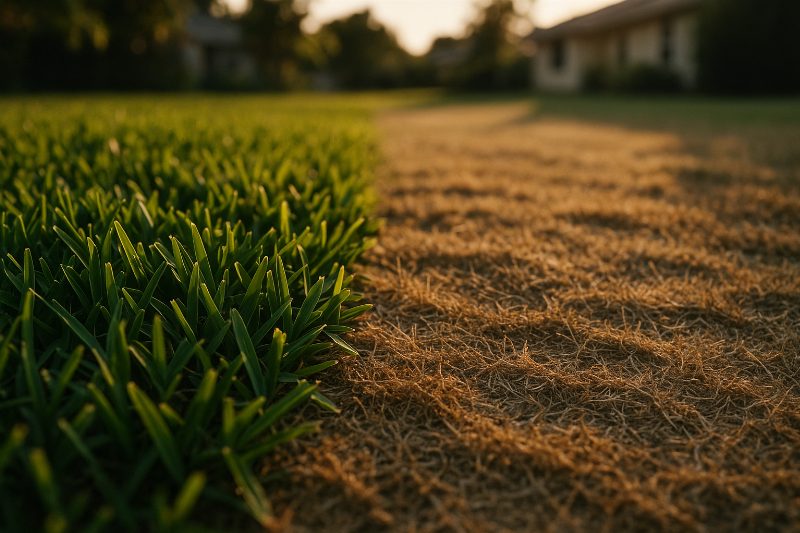
Cutting your grass a little shorter to stretch the time between mows seems harmless enough - until you look out the window a week later and wonder why your lawn looks sunburned, thin, and brown in patches. That's scalping, and it's one of the most common mistakes homeowners make with Florida turf.
This post breaks down exactly what scalping is, why it's so damaging (especially in our climate), which grass types are most vulnerable, and how to find the sweet spot that keeps your lawn thick, green, and stress-resistant through every season.
What Is Scalping, Exactly?
Scalping happens when you mow the grass so short that you remove not just the leaf blade tips but a significant portion of the green, photosynthesizing tissue - sometimes cutting all the way down to the pale, woody stem at the base of the plant. When you see a lawn that looks almost white or tan right after a mow, that's scalping. The grass was cut so aggressively that the green is simply gone.
It's worth understanding a little grass biology here. The leaf blade is the lawn's solar panel. It captures sunlight and converts it into the energy the plant uses to grow roots, produce new shoots, and fight off disease and pests. When you remove too much of that blade at once, you cut off the plant's ability to feed itself. The root system then has to support the whole plant using stored energy reserves while the grass scrambles to regrow. If you do that once in a while, healthy turf can bounce back. Do it repeatedly - or do it at the wrong time of year - and you're looking at lasting damage.
The One-Third Rule and Why It Matters So Much in Florida
The "one-third rule" is the single most important guideline in all of lawn mowing: never remove more than one-third of the grass blade's current height in a single mowing session. So if your St. Augustine grass is at 4 inches, you'd cut it to no shorter than about 2.5 to 3 inches. If it's at 6 inches because you skipped a week, cutting it all the way down to 2 inches means you've removed more than half the blade. That's a scalp.
In our part of Florida - Bradenton, Lakewood Ranch, Parrish, Palmetto, Ellenton, and out on Anna Maria Island - this rule matters even more than it does in cooler states. Here's why:
- Heat stress is constant. From May through September, ground temperatures can push past 100°F on a sunny afternoon. A full, dense blade of grass shades the soil and the plant's crown from that heat. Scalp the lawn, and you've stripped away that natural shade. The exposed crown and roots cook.
- Weeds love bare soil. Thin, scalped turf gives weed seeds exactly what they need: light, warmth, and room. Nutsedge in particular is notorious for pushing through weakened turf. If you're already battling that, check out our post on how to get rid of nutsedge in a Florida lawn for a strategy that works without making the scalping problem worse.
- Disease pressure is high. Stressed, scalped grass has almost no immune defense. Fungi like gray leaf spot thrive when turf is weakened. We see this connection play out every summer. You can read more about it in our guide to gray leaf spot: the summer fungus that loves St. Augustine grass.
The Right Mowing Heights for Florida's Most Common Grasses
Different turf varieties have different ideal mowing ranges. Cutting at the wrong height for your specific grass type is a setup for trouble.
St. Augustine grass is the most common turf across Manatee County and should be maintained at 3.5 to 4 inches during the growing season. This is taller than many homeowners think is "normal," but that height is what gives St. Augustine its signature density and shade tolerance. Dropping below 2.5 inches puts it squarely in scalp territory and opens the door to chinch bug damage that can look deceptively like drought stress - if you're not sure which problem you're dealing with, our post on chinch bugs vs. drought stress in St. Augustine grass walks through how to tell them apart.
Bahia grass, which you'll find on larger lots in Parrish and in some older neighborhoods in Palmetto, does well at 3 to 4 inches. It's a tough, drought-tolerant grass, but scalping it repeatedly will thin it out and invite weeds into the gaps.
Zoysia grass is a bit more forgiving and can be maintained at 1.5 to 2.5 inches, depending on the variety. Even so, the one-third rule still applies. Don't let it get long and then hack it down in one pass.
Bermuda grass, less common in home lawns here but present on some athletic fields and newer landscaped properties, tolerates shorter cuts - down to about 1 to 1.5 inches - but only when mowed frequently. Letting Bermuda grow tall and then cutting it short is a classic scalping scenario.
When Scalping Is (Carefully) Used on Purpose
There's one scenario where intentional scalping is a legitimate practice: at the very start of spring, before your warm-season turf breaks fully out of dormancy. Some lawn care professionals will scalp St. Augustine or Bermuda in late February or early March to remove the layer of dead winter growth, allow more sunlight to reach the soil and warm it up faster, and encourage even spring green-up.
But this is a specific technique, done once per year, at the right time, under the right conditions. It is not the same as mowing short all summer long. And even when done intentionally, it should be followed immediately by good cultural practices: watering, fertilization at the appropriate time, and close attention to the lawn's recovery. If you have questions about whether a spring scalp makes sense for your turf type and property, our FAQ page covers some of the most common timing questions we hear from homeowners.
The Damage That Builds Up Over Time
A single light scalp on a healthy lawn is usually recoverable. The grass looks rough for a week or two, then fills back in. The problem is that most homeowners who scalp their lawns don't do it just once. They set the mower deck too low and leave it there for the whole season. Every mow is a scalp. And that's where real, lasting damage accumulates.
Here's what chronic scalping does to a lawn over time:
- Root shallowing. Grass under constant stress from scalping puts energy into regrowing leaf blades rather than deepening its root system. Shallow roots mean the lawn is far more vulnerable to drought, heat, and disease.
- Crown exposure and death. The crown is the growing point of the grass plant, and it sits just above the soil surface. Repeated scalping can literally cut into or expose the crown to the point where individual grass plants die. Those dead spots don't grow back on their own - they need to be filled in by runners from neighboring plants, which takes time.
- Thatch problems. Weakened turf often develops a spongy, uneven thatch layer because the lawn can't maintain the balance of growth and decomposition. A bouncy thatch layer, in turn, causes mower wheels to sink unevenly - making scalping even worse in a frustrating feedback loop.
- Pest and disease vulnerability. Stressed turf is exactly what fungal diseases and insects are looking for. Mole crickets, for example, do their worst damage in already-weakened lawns. Our post on mole crickets and the tunnels they leave behind explains how to catch them before the damage compounds.
Mower Blade Height: Check It Before Every Season
One of the most overlooked causes of accidental scalping is a mower deck that isn't set where the homeowner thinks it is. Mower deck height indicators wear down, bend, or simply aren't accurate after years of use. The height setting marked "3" on your mower may not actually be delivering a 3-inch cut.
Here's a simple way to check: mow a small test strip, then use a ruler to measure the actual height of the remaining grass blade. Do this at the start of each mowing season and any time you switch turf areas or lend your mower to someone else. It takes two minutes and can save you weeks of recovery time.
Also make sure your mower blade is sharp. A dull blade doesn't cut - it tears and shreds the grass tip, leaving a ragged, white-looking edge that turns brown and creates stress even without any scalping involved. Sharpen or replace your blade at least once per season, and more often if you're mowing a large property or running over gravel and roots.
Ground Contours and Scalping Risk
Flat lawns are relatively easy to mow without scalping. But in neighborhoods around Lakewood Ranch and Bradenton, where many properties have subtle rises, berms, and drainage swales, the risk of scalping is much higher. When a mower wheel drops into a low spot or crests a rise, the deck suddenly gets closer to the ground, and that high point gets scalped even if the overall deck height is correct.
If you're dealing with an uneven lawn, the solution isn't to raise the deck so high that you're barely cutting. The right answer is to address the underlying grading issue and use slower, more deliberate mowing passes on contoured areas. A professional mowing crew learns the terrain of a lawn quickly and adjusts blade speed and direction accordingly.
What Recovery Looks Like - and When to Call for Help
If you've already scalped your lawn, don't panic and don't make it worse. The immediate steps:
- Stop mowing for two to three weeks (or at least until the grass has clearly regrown to the proper height range).
- Water properly. Scalped grass is under heat stress. Consistent moisture helps it recover, but don't overwater - soggy soil on weakened turf invites root rot.
- Hold off on fertilizer right after a scalp. The grass needs to stabilize before it can use nutrients effectively, and pushing it hard while it's stressed can cause more harm than good.
- Watch for disease and bare patches. If areas fail to fill back in after three to four weeks, you may be looking at take-all root rot or another underlying issue. Our post on take-all root rot and bare patches that refuse to recover explains the signs and what actually works for treatment.
If you're not sure what your lawn needs after a scalp, or if the damage looks more serious than a few brown spots, it's worth getting a professional eye on it. Our team works across Bradenton lawn care, Lakewood Ranch, Palmetto, and the surrounding communities, and we're happy to take a look and give you an honest assessment.
The Simple Fix: Mow High, Mow Often, and Stay Consistent
The best protection against scalping is also the simplest: keep your mower deck at the right height for your grass type, mow before the lawn gets away from you, and stick to the one-third rule every single time. A lawn that's mowed at 3.5 to 4 inches consistently is denser, more drought-tolerant, better at crowding out weeds, and far more resistant to the pests and diseases that give Florida homeowners headaches every summer.
You don't need special products or complicated schedules. You just need the right height, a sharp blade, and enough consistency that you're never taking off more than a third at a time.
If you'd rather hand that job off to a team that knows local turf, take a look at our lawn care and landscaping services or get in touch to talk about what your lawn needs. We've been caring for lawns across Manatee County long enough to know every neighborhood's quirks - and how to keep Florida grass looking its best without cutting it to pieces.