
Gray Leaf Spot: The Summer Fungus That Loves St. Augustine
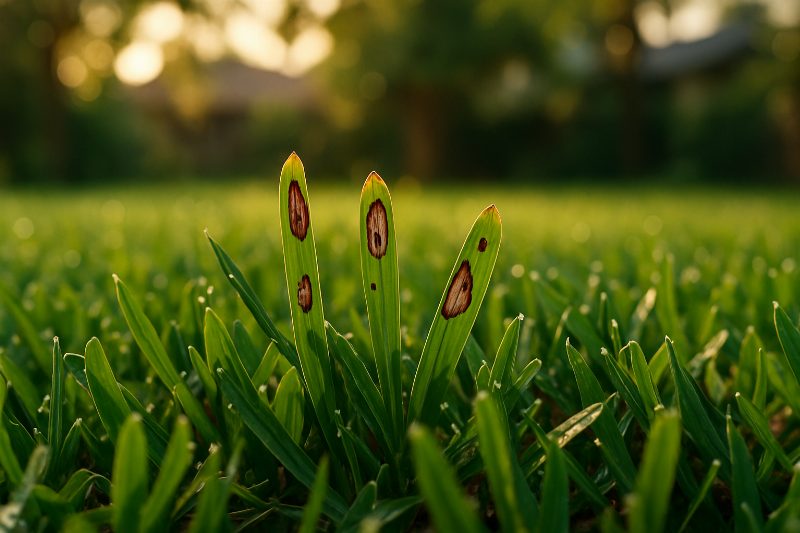
Gray leaf spot does not announce itself politely. One week your St. Augustine lawn looks full and green, and the next you are staring at tan, water-soaked lesions spreading across blades faster than you can figure out what went wrong. If you live in Bradenton, Lakewood Ranch, Parrish, or anywhere else along Florida's Gulf Coast, this fungus is one of the most common and most misunderstood problems your lawn will ever face.
This post covers everything you need to know: what causes it, how to tell it apart from other issues, what treatments actually work, and most importantly, how to change the conditions in your yard so the fungus never gets a foothold again.
What Is Gray Leaf Spot, Exactly?
Gray leaf spot is a fungal disease caused by the pathogen Pyricularia grisea (sometimes listed as Magnaporthe grisea). It targets warm-season grasses, but it has a particular fondness for St. Augustine grass, which is the most common turf grass across Manatee County and the surrounding area. Zoysiagrass and centipedegrass can also be affected, but St. Augustine is where it causes the most visible and rapid damage.
The fungus produces spores that spread through water splash, wind, and foot traffic. Once a spore lands on a blade of grass under the right conditions, it germinates and begins to infect the leaf tissue within hours. The disease does not need a wound or weak spot to enter the plant. It can penetrate healthy leaf tissue directly, which is part of why it spreads so aggressively.
Why Florida Summers Create Perfect Conditions
Here is the uncomfortable truth about living in a place as beautiful as Anna Maria Island or Ellenton: the same warm, wet weather that makes the Gulf Coast so appealing is exactly what gray leaf spot needs to thrive.
The fungus grows fastest when:
- Temperatures stay between 80°F and 95°F - which describes virtually every day from May through September here
- Humidity is consistently high - Florida's summer air rarely drops below 70% relative humidity
- Leaf surfaces stay wet for 6 hours or more - afternoon thunderstorms followed by warm, still nights make this almost unavoidable
- Nitrogen is abundant in the leaf tissue - more on this critical point below
Coastal communities like Palmetto and Anna Maria Island get an extra dose of warm, moist air off the water, which can extend gray leaf spot season and make outbreaks more severe than they might be a few miles inland.
Identifying Gray Leaf Spot: What to Look For
Correct identification is the first and most important step. Many homeowners mistake gray leaf spot for drought stress, chinch bug damage, or other fungal diseases, and then apply the wrong treatment, which at best wastes money and at worst makes the lawn worse.
Early-stage symptoms:
- Small, olive-green or water-soaked spots appear on individual blades, usually starting on the newer growth
- Spots are roughly circular to slightly oval, about the size of a match head
- The spots have a grayish or tan center with a distinct brown or purple border
As the disease progresses:
- Lesions elongate and take on a more irregular shape
- The center turns gray to ash-tan and the surrounding border darkens to reddish-brown or purple
- Severely infected blades turn yellow, then tan, and die back from the tip
- In heavy outbreaks, entire sections of lawn look scorched or dried out, even when soil moisture is adequate
One helpful field test: Go out to the lawn early in the morning when dew is still present. Look at the lesions with a hand lens or your phone camera zoomed in. Active gray leaf spot lesions often show a velvety or powdery gray coating of spores in humid conditions. That coating is the fungus sporulating, and it confirms your diagnosis better than almost anything else.
If you are not sure whether you are dealing with gray leaf spot or something that looks similar, take a look at our post on chinch bugs vs. drought stress in St. Augustine grass for a comparison of symptoms. Bare patches that refuse to green back up after rain may point to a different problem entirely, covered in detail in our guide to Take-All Root Rot.
The Biggest Mistake Homeowners Make: Over-Fertilizing in Summer
If there is one cultural practice that fuels gray leaf spot more than anything else, it is applying a high-nitrogen fertilizer to St. Augustine grass during the hot, rainy summer months.
Nitrogen pushes soft, lush new growth. That tender leaf tissue is exactly what the fungus prefers. Think of it like feeding the fungus a gourmet meal right when the weather conditions are already perfect for it to multiply. Many homeowners look at their lawn in June or July, see it looking a little tired, and reach for a bag of quick-release nitrogen fertilizer. Within two to three weeks, they are often dealing with a serious gray leaf spot outbreak.
Florida's own fertilizer blackout periods exist partly for this reason. Manatee County's ordinances restrict fertilizer applications during the rainy season, generally from June 1 through September 30. Beyond the regulatory issue, it is simply bad lawn management to push nitrogen on St. Augustine during peak gray leaf spot season.
What to do instead:
- If your lawn needs a nutrient boost in summer, use a slow-release fertilizer with a lower nitrogen percentage
- Focus any fertilization on the shoulder seasons: early spring (March through early May) and fall (October through November)
- Have your soil tested before fertilizing so you are correcting actual deficiencies rather than guessing
Irrigation Habits That Invite the Fungus In
Overwatering is the second major cultural problem that feeds gray leaf spot. Watering in the late afternoon or evening leaves leaf surfaces wet throughout the night, giving fungal spores hours to germinate undisturbed.
The right approach is to water deeply and infrequently, and to water in the early morning so the sun and daytime heat can dry off the grass before evening. A St. Augustine lawn in our area typically needs about one inch of water per week during the summer, including rainfall. With afternoon thunderstorms rolling through Bradenton and Lakewood Ranch almost daily from June through August, you may need little to no supplemental irrigation at all during those months.
Check your irrigation controller and make sure it is not running on a fixed schedule regardless of rainfall. A rain sensor or a smart irrigation controller that adjusts based on local weather data is a genuinely worthwhile investment for any homeowner serious about lawn health.
Fungicide Treatments: When They Are Needed and How to Use Them
Cultural changes (adjusting fertilizer, fixing irrigation timing) are the foundation of gray leaf spot control. But when an active outbreak is spreading rapidly, a fungicide application can slow or stop the damage while you address the underlying conditions.
Effective active ingredients to look for:
- Azoxystrobin (a strobilurin class fungicide) - works well as a preventive and early curative treatment
- Pyraclostrobin - another strobilurin, often combined with other active ingredients for broader coverage
- Trifloxystrobin - similar mode of action to the above two
- Thiophanate-methyl - a systemic fungicide in a different chemical class, useful for rotation
Resistance management matters. The Pyricularia fungus can develop resistance to strobilurin fungicides if you rely on the same product repeatedly. Rotate between products with different modes of action (different FRAC group numbers) to keep treatments effective over time.
Application tips:
- Apply in the early morning or evening to reduce evaporation and leaf burn risk
- Follow label rates exactly - more is not better and can damage turf
- Plan for at least two applications, 14 to 21 days apart, for an active outbreak
- Do not mow immediately after applying; give the product at least 24 hours to dry and absorb
For severe outbreaks covering large areas, a professional application is often more cost-effective and reliable than repeated DIY attempts. Our team handles lawn care and landscaping services across Manatee County, including fungicide programs tailored to Florida's specific disease pressure calendar.
Mowing Practices That Affect Disease Spread
Mowing a lawn during an active gray leaf spot outbreak can spread spores across a large area quickly. Blades that cut through infected leaf tissue send fungal material flying across the lawn, and a dull mower blade that tears rather than cuts creates more open wound surface for new infections.
Practical steps:
- Mow at the correct height for St. Augustine grass, generally between 3.5 and 4 inches. Scalping the lawn stresses the grass and leaves it more vulnerable.
- Keep your mower blades sharp. A clean cut heals faster and gives fungal spores fewer entry points.
- If you are mowing during an active outbreak, bag the clippings instead of mulching them back into the lawn.
- Rinse and wipe down mower decks and wheels before moving from an infected area to a healthy one.
What a Recovered Lawn Looks Like and How Long It Takes
With proper treatment and corrected cultural practices, St. Augustine grass can recover from gray leaf spot. New growth coming in from the stolons (the horizontal stems that spread across the surface) will be healthy and green, and it will gradually fill in areas where blades died back.
Recovery time depends on how severe the outbreak was and how quickly conditions are corrected. A mild to moderate case caught early may show clear improvement within three to four weeks. A severe outbreak that ran unchecked through a wet July might take the rest of the growing season to fill back in fully.
Patience is important here. Resist the urge to over-fertilize to "help" the lawn recover. That is the exact mistake that often triggers a second outbreak.
Other Summer Lawn Problems to Watch for Alongside Gray Leaf Spot
Gray leaf spot does not always show up alone. Florida summers create conditions where multiple stresses hit a lawn at the same time, and the symptoms can overlap in confusing ways.
Keep an eye out for:
- Mole crickets, which tunnel through soil and damage roots. Our guide on mole crickets and the tunnels they leave behind explains what to look for.
- Nutsedge, a persistent weed that loves the same wet conditions gray leaf spot thrives in. We break down how to get rid of nutsedge in a Florida lawn and keep it from coming back.
- Fire ants, which are a year-round issue in Manatee County but build up faster during summer rains. Read our post on fire ant control for Manatee County yards for treatment options that will not damage your turf.
Dealing with more than one problem at once is common, and it is one reason a professional set of eyes on your lawn can be more valuable than working through issues one at a time on your own.
When to Call a Professional
Gray leaf spot is manageable as a DIY project if you catch it early and are willing to make the cultural changes needed to stop it from returning. But there are situations where calling in a professional makes more sense:
- The outbreak has spread to a large portion of the lawn and is still actively spreading
- You have already applied a fungicide without improvement, suggesting a possible resistance issue or misdiagnosis
- The lawn has multiple overlapping problems that are difficult to sort out
- You want a preventive fungicide program set up before next summer's rainy season begins
Our team serves homeowners across Bradenton, Lakewood Ranch, Parrish, Palmetto, Ellenton, and Anna Maria Island. If you are not sure what is happening to your lawn or you would like help putting together a disease management plan, reach out and we are happy to take a look.
The Short Version
Gray leaf spot is a fast-moving, weather-driven fungal disease that St. Augustine grass is particularly vulnerable to. Florida's summer climate is almost tailor-made for it. The good news is that the most important controls are not expensive or complicated. Getting your fertilizer timing right, fixing your irrigation schedule, mowing at the correct height with a sharp blade, and acting quickly when symptoms appear will handle the vast majority of outbreaks. When you need extra help, the right fungicide applied correctly can stop an active case in its tracks.
A healthy lawn going into summer is your best defense. Give your St. Augustine the conditions it needs to grow strong, and it will have the built-in resilience to shrug off what summer throws at it.