
Why Your Sprinkler System May Be Wasting Water and Money
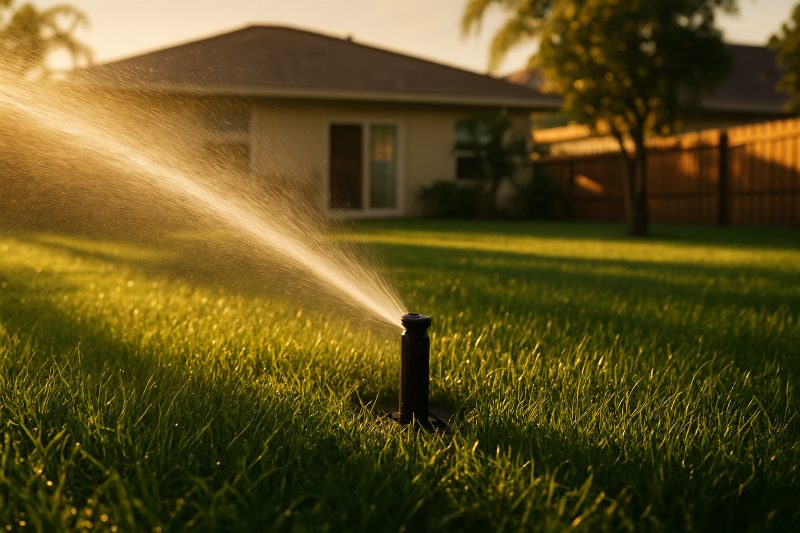
Most homeowners in Bradenton and Lakewood Ranch assume their sprinkler system is doing its job. The grass is green, the heads are popping up on schedule, and the timer is set. But "on" and "efficient" are two very different things, and the gap between them often costs hundreds of dollars a year in wasted water.
The truth is, irrigation inefficiency is one of the most common problems we see when we walk a lawn for the first time. It's also one of the most fixable. This post walks you through the real reasons your system may be wasting water, how to diagnose each problem, and what to do about it before your next water bill arrives.
Florida's Irrigation Reality Is Different From Everywhere Else
Homeowners who moved here from up north often bring irrigation habits that made sense in Ohio or Michigan and make no sense at all in Manatee County. Up north, the soil holds moisture for days. Here, our sandy soil drains fast. Our summers bring heavy afternoon rain almost daily. Our winters are dry, but the grass grows slowly and needs far less water.
Layer in the fact that most of this area sits under water restrictions set by the Southwest Florida Water Management District (SWFWMD), and you have a situation where the stakes for inefficiency are higher than most people realize. Running your system on the wrong days or at the wrong times isn't just wasteful, it can earn you a warning or a fine.
Understanding how your lawn actually uses water in this climate is the first step. The rest of this post covers the specific mechanical and scheduling mistakes that turn a reasonable irrigation bill into an unreasonable one.
Problem 1: Your Schedule Hasn't Changed in Years
The single most common source of waste we find is a timer that was programmed once and never touched again. A schedule set in March, during dry season, is almost certainly still running the same zones for the same duration every week in July, when afternoon thunderstorms are delivering an inch or more of rain on their own.
What you should do: Check your timer monthly. During our rainy season (roughly June through September), most lawns in Parrish, Ellenton, and Palmetto need little to no supplemental irrigation. If your schedule is running three or four days a week during that stretch, you are almost certainly overwatering.
Better yet, install a rain sensor if you don't already have one. They cost between $15 and $60 at any hardware store and are required by Florida law on all new irrigation systems. The sensor tells your controller to skip a scheduled run after measurable rainfall. It's one of the cheapest upgrades you can make and one of the most effective.
If your controller is more than ten years old, consider replacing it with a smart irrigation controller that pulls local weather data automatically. These devices adjust run times based on rainfall, temperature, and evapotranspiration rates. Many local utilities offer rebates on smart controllers, so it's worth a quick call before you buy.
Problem 2: Heads Are Spraying the Wrong Places
Stand outside during a scheduled irrigation cycle and actually watch where the water goes. You may be surprised. Sprinkler heads shift over time. Mowers clip them. Soil settles. A head that was aimed perfectly at installation might now be throwing half its water onto your driveway, sidewalk, or the road.
This is called overspray, and it's pure waste. In a neighborhood like Anna Maria Island or along the streets of Lakewood Ranch, you'll often see water sheeting across driveways and into gutters while the grass two feet away stays dry.
What to look for:
- Heads visibly spraying pavement, fences, or structures
- Puddles forming on hard surfaces during a cycle
- Dry patches right next to wet areas (a sign of misalignment or blocked spray)
- Heads that aren't rotating fully or are stuck in one position
Adjusting a spray head is usually a matter of turning the adjustment screw or nozzle cap. Rotor heads (the ones that rotate back and forth) have an arc adjustment that can be reset with a flat-head screwdriver or the key tool that came with your system. If you're unsure how, a quick irrigation check from a lawn care professional can identify all the misaligned heads at once and fix them in a single visit.
Problem 3: You Have the Wrong Head Types Mixed Together
This one catches a lot of homeowners off guard. If your yard has a mix of rotor heads and spray heads on the same zone, those heads apply water at very different rates. Rotors throw water slowly over a wide arc. Sprays apply water much faster over a fixed pattern.
When they run together, the spray heads are usually done in 5-6 minutes and the rotors are still working. You end up either under-watering the rotor areas or flooding the spray areas. This mismatch is surprisingly common in older systems or in systems that were expanded over the years with mismatched parts.
The fix: Each zone should contain only one type of head. If you have a mix, either convert the zone or split it into two. This is more involved work, but it resolves the mismatch permanently.
Problem 4: Your Run Times Don't Match Your Soil
Sandy Florida soil, which covers most of Manatee County, has very low water-holding capacity. Water moves down through it quickly, which means long run times per zone actually push water below the root zone where the grass can't reach it. You're essentially irrigating the subsoil.
The recommended approach for sandy soil is short, frequent cycles (or "cycle and soak"). Instead of running a zone for 15 minutes straight, run it for 5 minutes, let the water soak in, then run it again later in the same cycle. Most modern controllers have a cycle-and-soak function built in.
The right run time depends on your head type, water pressure, and soil, but a general starting point for St. Augustine grass (the most common turf here) is roughly:
- Spray heads: 10-15 minutes per zone per watering day
- Rotor heads: 25-40 minutes per zone per watering day
These are starting points, not fixed rules. If you're seeing runoff before the cycle ends, your time is too long. If the grass wilts and shows footprinting (where footprints remain visible in the turf), you may need slightly more time or an additional watering day.
Problem 5: You're Watering at the Wrong Time of Day
Watering in the middle of the day wastes water to evaporation before it ever reaches the roots. Watering at night leaves the grass wet for too long, which encourages fungal diseases like [gray leaf spot](./blog/gray-leaf-spot-summer-fungus-st-augustine-grass), a destructive summer fungus that thrives on St. Augustine lawns right here in our area.
The correct window is early morning, ideally between 4 a.m. and 8 a.m. The water has time to soak in before the heat of the day, and the turf dries out quickly once the sun rises, which keeps disease pressure low.
If your timer is set for any other time window, change it today. It's one of the simplest, fastest adjustments you can make and it directly reduces both your water bill and your risk of lawn disease.
Problem 6: Leaks You Don't Know About
A slow leak at a head, a cracked lateral line, or a faulty solenoid valve can bleed water continuously, even when the system is off. These leaks are often invisible from the surface, especially if they're happening underground.
Signs of a potential leak include:
- An area of lawn that is always wet or muddy
- A zone that seems to water unevenly, with one spot significantly wetter
- A water bill that spikes without any change in your schedule
- A head that dribbles or seeps after the cycle ends
If you notice any of these, turn off that zone and watch whether the wet spot persists. A consistently soggy area when irrigation is off is a reliable indicator of a pressurized leak somewhere in the line. Getting it repaired promptly is worth it. Even a small drip under pressure can waste hundreds of gallons a week.
Problem 7: You're Not Adjusting for Seasonal Changes
Florida has two distinct irrigation seasons, and treating them the same is a guaranteed way to waste water. Our dry season (roughly October through May) does require supplemental irrigation, though less than most people run. Our wet season (June through September) usually requires very little irrigation at all.
A lawn in the Bradenton area or [Lakewood Ranch](./locations/lakewood-ranch) during a typical July week may get two or three inches of rain from afternoon storms. Running a full irrigation schedule on top of that saturates the soil, pushes disease, and kills grass from overwatering just as surely as drought does.
Get in the habit of checking the weekly forecast before each irrigation day. If rain is coming, skip the cycle manually. If your smart controller handles this automatically, confirm it's connected and updating.
What Healthy Irrigation Actually Looks Like
A well-managed sprinkler system should apply about three-quarters of an inch of water per zone per application on sandy soil. Many homeowners use a simple "tuna can test" to measure output: place several straight-sided cans in different spots across a zone, run the system for your normal duration, then measure the depth of water collected. This tells you both how much you're applying and whether coverage is even across the zone.
If some cans fill significantly more than others, you have a distribution problem (a clogged head, a head at the wrong angle, or a pressure issue). If all the cans together hit three-quarters of an inch quickly, your run time may be longer than it needs to be.
Even minor improvements to irrigation efficiency pay back over time. Less water means lower bills. Proper timing means less disease. Dialing in your coverage means greener grass with fewer problem spots, which is exactly the kind of lawn that doesn't need expensive interventions down the road.
When to Call in a Professional
If all of this sounds like a lot to sort through on your own, it is reasonable to bring in someone who does it every day. A thorough irrigation audit covers every zone, checks head alignment and output, tests for leaks, reviews your controller settings, and gives you a clear picture of what your system is doing versus what it should be doing.
Our team works with homeowners throughout [Bradenton](./locations/bradenton), [Palmetto](./locations/palmetto), [Parrish](./locations/parrish), [Ellenton](./locations/ellenton), and the surrounding communities. We see irrigation problems every week, and most of them are straightforward to fix once they're identified. You can [explore our full lawn care and landscaping services](./services) to see how irrigation fits into the bigger picture of keeping your lawn healthy, or [get in touch with us directly](./contact) to schedule an assessment.
Irrigation problems rarely announce themselves loudly. They just quietly add dollars to your water bill and stress to your lawn, season after season. Taking a close look at your system now is one of the most cost-effective things you can do for your lawn and your wallet.
And if you're dealing with other lawn issues that might be masking or compounding irrigation trouble, it's worth reading up on problems like [chinch bugs versus drought stress](./blog/spotting-chinch-bug-damage-st-augustine-grass) and [take-all root rot](./blog/take-all-root-rot-bare-patches-lawn), since both of these are frequently misdiagnosed as irrigation failure. Getting the full picture means solving the right problem the first time.