
Why your St. Augustine lawn looks purple in winter
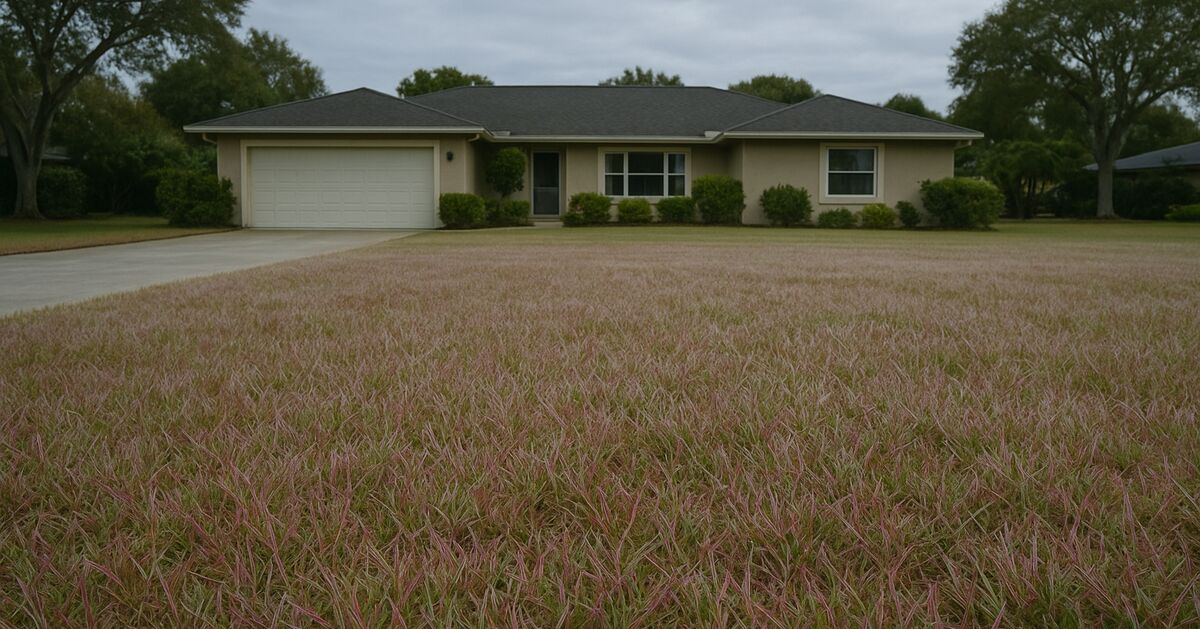
That purple-red blush spreading across your St. Augustine grass every December is one of those lawn mysteries that sends homeowners reaching for the phone. Pest damage? Fungus? A fertilizer gone wrong? Often, the answer is simpler, and understanding it will save you both money and unnecessary chemical treatments.
What is actually happening inside the grass blade
St. Augustine grass (Stenotaphrum secundatum) is a warm-season turf that evolved in tropical and subtropical climates. When soil temperatures dip below roughly 60°F, the grass enters a state of reduced metabolic activity. One of the most visible effects of that slowdown is a change in leaf pigmentation.
Under cold stress, St. Augustine grass produces elevated levels of anthocyanins, a class of water-soluble pigments that are naturally present in many plants. Anthocyanins absorb blue-green light and reflect red and purple wavelengths, which is exactly what you see on your lawn on a cold morning in January. According to research published through the University of Florida IFAS Extension, this pigment accumulation is a protective response, a way the plant shields its photosynthetic machinery from light damage during periods when it cannot efficiently process that light due to cold temperatures.
The discoloration typically shows up first on the tips and margins of the leaf blades, then spreads more broadly across the lawn as cold nights persist. You may notice it is most intense on the sections of your lawn that get the most direct morning sun after a cold night, which is counterintuitive but makes sense once you understand the mechanism: more light hitting cold, metabolically sluggish tissue means more need for that pigment protection.
Lawns in Parrish and Palmetto tend to see this a little more dramatically than neighborhoods closer to the water, because inland areas of Manatee County experience a wider swing between daytime highs and nighttime lows during December through February. Anna Maria Island and coastal Bradenton benefit from the thermal mass of Tampa Bay and the Gulf, which buffers nighttime temperatures and often keeps turf a shade greener through the cool months.
Purple versus other problems: how to tell the difference
The fact that purpling is common does not mean every purple or reddish discoloration on your lawn is just a cold response. Two other problems can produce similar colors and you need to rule them out.
Phosphorus deficiency can cause a purple or reddish tinge that looks almost identical to cold-stress anthocyanin coloring. Phosphorus is a critical component of ATP, the molecule plants use to transfer energy, and when a plant is starved of it, pigment chemistry goes off balance. Phosphorus deficiency may be less common than it once was in Florida lawns, but a soil test is the only way to confirm your soil's actual phosphorus level. A soil test is the only way to know for certain. The University of Florida IFAS Extension recommends conducting a soil test before applying phosphorus, since excess phosphorus in Central and Southwest Florida can run off into waterways and contribute to water quality problems.
Chinch bug feeding damage can leave St. Augustine grass with yellowish, reddish, and bronze patches that sometimes look purple-ish in certain light. The key difference is pattern and texture: chinch bug damage tends to spread from hot, dry areas of the lawn outward in irregular patches, and the grass in those patches will be thin, dying, or already dead when you part the blades. Cold-stress purpling covers the lawn more uniformly and the individual blades still feel firm and intact. If you want a deeper look at telling those two apart, our post on chinch bugs versus drought stress walks through the identification steps.
To confirm cold-stress purpling, simply wait. If overnight lows climb back above 60°F for several days in a row and the purple fades on its own, cold stress was your answer.
Why the timing matters: what phosphorus has to do with cold weather
Here is a detail that trips up many homeowners. Even if your soil has plenty of phosphorus, cold soil can make it functionally unavailable to your grass. Phosphorus uptake is a biologically active process, and root metabolism slows sharply in cold soil. So a lawn that would show zero phosphorus deficiency symptoms in July can flash purple in January even if you fertilized it correctly all year. This temporary nutrient uptake issue tends to resolve on its own as soil temperatures warm.
This is important because it tells you what NOT to do: do not panic-apply a high-phosphorus fertilizer to a purple lawn in January. Manatee County has rules restricting nitrogen and phosphorus during the rainy season, and applying phosphorus in winter when grass cannot use it risks having that nutrient wash into local waterways during rain. If you have questions about what you can and cannot apply and when, our FAQ page covers the Manatee County and SWFWMD fertilizer calendar in plain language.
What the soil temperature actually needs to be
Soil temperature is the number you want to watch, not the air temperature. Air temperature can dip into the low 50s on a clear night and rebound into the 70s by afternoon. Soil temperature changes much more slowly, which is actually what protects grass roots. A few isolated cold nights will not drop a lawn's soil temperature dramatically.
You can check Florida soil temperature data through the Florida Automated Weather Network (FAWN), operated by the University of Florida IFAS, which provides real-time and historical soil temperature readings at multiple depths from weather stations across the state, including locations near Manatee County. Watching that data point over a week tells you far more than looking at the overnight low on your weather app.
When soil temperatures stay consistently below 55°F, St. Augustine essentially stops growing. The lawn is not dead, it is dormant, and this is completely normal for Southwest Florida winters even though our winters are mild by national standards.
Practical steps you can take right now
If your lawn is currently purple and you want to manage it well, here is what actually helps.
Do not fertilize with nitrogen right now. Pushing nitrogen into a lawn that has slowed down does not green it up, it just wastes fertilizer and puts nitrates at risk of leaching before the grass can use them. Per the University of Florida IFAS Extension's guidelines for St. Augustine management, fall fertilization should be completed before the grass begins to slow down, generally by early October in Southwest Florida.
Do not raise your mowing height dramatically. Some homeowners raise the mowing deck thinking it will help the grass hold in warmth. A modest adjustment is fine, and our lawn care services team generally recommends going up one notch on the deck during cool months. But leaving grass excessively tall increases humidity at the soil surface and can actually promote fungal diseases like brown patch, which is already a winter concern in our climate.
Keep your irrigation dialed back. Grass that is not growing needs far less water. Overwatering a dormant or semi-dormant St. Augustine lawn in winter is one of the more reliable ways to invite fungal problems. Many Manatee County properties follow a two-day-per-week irrigation schedule, and in winter your lawn will typically be fine with even less water than that.
Leave the leaves and clippings in moderation. A light layer of clippings returns small amounts of nutrients to the soil and does not require removal. Heavy leaf accumulation from live oaks can smother turf over winter if left untouched, so stay on top of it, but do not feel you need to rake after every mow.
Consider a soil test in late winter. If the purple is intense and persists well into February and March even when nights are mild, that is a reasonable signal to test your soil. A soil test through the University of Florida IFAS Extension's soil testing lab costs very little and tells you whether phosphorus is actually deficient or whether something else in your soil chemistry needs attention. It also gives you a legitimate baseline before deciding what to apply in spring.
What to expect as spring approaches
As consistently warm weather returns, typically March through early April in Manatee County, you will watch the purple fade from the tips of the blades first, then across the whole lawn. The grass will start producing new growth in a healthy medium-green that gradually replaces the discolored older tissue. If you have been caring for your lawn well through the winter, this green-up happens reliably and relatively quickly.
If a section of your lawn remains discolored after the rest has greened up and nights have been warm for several weeks, that is worth a closer look. Persistent discoloration in one area that does not recover with warm temperatures could indicate compaction, a drainage issue that is keeping roots cold and wet, or possibly a localized pest or disease problem that developed over winter.
For homeowners in Lakewood Ranch and Ellenton, where new construction sometimes means recently installed sod that has not fully established its root system, post-winter recovery can take a few extra weeks. Young roots that did not have a full growing season to establish before the cold arrived are more susceptible to stress and slower to bounce back.
When to call a professional
If you are unsure whether what you are looking at is cold-stress purpling or something more serious, a quick visit from a lawn care professional can save you from applying the wrong treatment at the wrong time. A misapplied fertilizer, fungicide, or pesticide in winter can do more harm than simply watching and waiting.
The Manatee Lawn Care team serves Bradenton, Lakewood Ranch, Palmetto, Parrish, Ellenton, and Anna Maria Island year-round, and a quick assessment in winter costs far less than repairing damage done by an incorrect treatment. You can also browse our full service area to confirm we cover your neighborhood.
One last note: because fertilizer timing questions come up alongside this topic often, it is worth reading our post on iron versus nitrogen for greening up your lawn during the summer fertilizer ban. Many of the same principles apply in reverse during winter, and understanding what your grass actually needs versus what it cannot use at a given time of year is the foundation of smart, sustainable lawn care in Southwest Florida.
The purple will pass. Understanding why it happens puts you in a much better position to care for your turf through every season.
Sources & further reading
- St. Augustinegrass for Florida Lawns (University of Florida IFAS Extension)
- Soil Testing for Home Lawns and Gardens (University of Florida IFAS Extension)
- Florida Automated Weather Network (FAWN) soil temperature data (University of Florida IFAS Extension)
- Fertilizer Applicator Training for Urban/Suburban Landscapes (University of Florida IFAS Extension)
- UF/IFAS Extension (named in this article) (UF/IFAS Extension)
Claim-by-claim audit (5 checked)
- “Inland lawns may show more dramatic purpling than coastal ones, since inland areas typically see wider temperature swings between day and night in winter.” (rewritten to what the article can stand behind)
- “Phosphorus deficiency may be less common than it once was in Florida lawns, but a soil test is the only way to confirm your soil's actual phosphorus level.” (rewritten to what the article can stand behind)
- “This temporary nutrient uptake issue tends to resolve on its own as soil temperatures warm.” (rewritten to what the article can stand behind)
- “Manatee County has rules restricting nitrogen and phosphorus during the rainy season, and applying phosphorus in winter when grass cannot use it risks having that nutrient wash int…” (rewritten to what the article can stand behind)
- “Many Manatee County properties follow a two-day-per-week irrigation schedule, and in winter your lawn will typically be fine with even less water than that.” (rewritten to what the article can stand behind)