
Iron, not nitrogen: greening up your lawn during the summer fertilizer ban
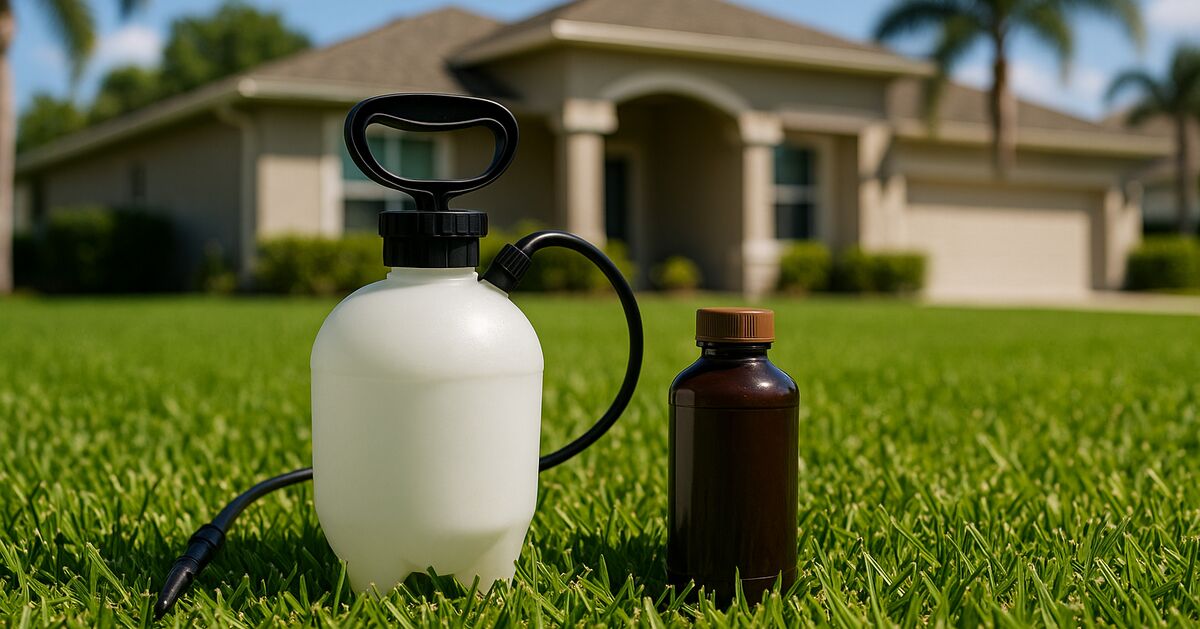
Your lawn does not have to turn pale and yellow just because the fertilizer bag is locked away for the summer.
Every year from June 1 through September 30, Manatee County's summer fertilizer ordinance prohibits applying nitrogen and phosphorus to lawns. The rule exists for good reason: heavy summer rains flush nutrients off lawns and into waterways, feeding the algae blooms that harm Tampa Bay and the Manatee River. Most homeowners know they have to put the fertilizer spreader away. What far fewer homeowners know is that a simple, inexpensive, fully legal alternative can keep their grass a rich, satisfying green all the way through the rainy season. That alternative is iron.
This post explains exactly how iron works in grass, how to apply it, which products to look for, and what realistic results you can expect here in Bradenton, Lakewood Ranch, Palmetto, Parrish, and across the rest of our lawn care service area.
Why grass turns light green or yellow in summer
Before getting into iron, it helps to understand what is actually going on when your lawn fades. Pale, yellowish grass in summer is usually one of two things: nitrogen deficiency or iron chlorosis, and they look surprisingly similar from the curb.
Nitrogen deficiency produces an overall light, washed-out green across the whole lawn. Iron chlorosis tends to show up as yellowing between the leaf veins while the veins themselves stay green, a pattern called interveinal chlorosis. Either way, the lawn looks tired and embarrassing right when the neighborhood is most likely to notice it.
Here is the catch. During the ban months, you cannot legally fix nitrogen deficiency with fertilizer. But iron chlorosis can be corrected easily and legally with supplemental iron, and the color response from iron is fast and dramatic enough that even lawns suffering mainly from nitrogen deficiency will look noticeably better after an iron application. The color is not the same as a nitrogen flush (iron deepens and darkens the green rather than pushing rapid growth), but that darker, richer color is exactly what most homeowners want.
What iron actually does inside a grass plant
Iron does not feed grass the way nitrogen does. Nitrogen is a building block that grass uses to construct chlorophyll and protein, which is why nitrogen drives leaf growth. Iron plays a different role: it acts as a catalyst that allows the grass plant to produce chlorophyll in the first place. Without enough available iron, the plant cannot synthesize chlorophyll even if every other nutrient is plentiful. The result is that pale, washed-out color.
Florida soils, including the sandy soils common throughout Manatee County, tend to have adequate total iron content. The problem is availability. High soil pH, common in areas with shell-rich or limestone-influenced soils, ties iron up into forms the grass roots cannot absorb. Waterlogged soils during the rainy season can also temporarily block iron uptake. So the grass is not necessarily starving for iron in an absolute sense; the iron is just chemically locked away. A foliar iron application sidesteps the soil problem entirely by delivering iron directly to the leaf tissue, where it goes to work almost immediately.
The fertilizer ban rules, briefly
Manatee County's ordinance mirrors similar rules across the Tampa Bay region. From June 1 through September 30, you may not apply any fertilizer containing nitrogen or phosphorus to turf or landscape plants. The ban does not apply to potassium, iron, or micronutrients. It does not apply to soil amendments like compost or lime. And it does not apply to new sod installation under specific conditions (you can read more about managing new turf in our post on new sod turning brown and those critical early weeks).
Iron supplements contain no nitrogen and no phosphorus, which is why they sail right through the ordinance. You are fully legal applying them any time during the ban. That said, always read the product label; a few "iron fertilizers" on store shelves sneak small amounts of nitrogen in alongside the iron. If a product lists any percentage next to the N on the NPK label, set it aside and find one with 0-0-0 on the bag. Our post on reading a fertilizer bag and what those three NPK numbers mean walks through how to decode that label quickly.
Forms of iron and which ones work best on turf
Walk into any garden center and you will find several iron options. They are not all equally effective on lawns.
Ferrous sulfate (iron sulfate)
This is the most common and most affordable iron source. It works well as a foliar spray and also acidifies the soil slightly, which can help loosen chemically bound iron in high-pH soils over time. The main downside: it stains concrete, pavers, and driveways a rust-orange color that is genuinely difficult to remove. If you apply it as a spray, be precise. Keep it off hard surfaces entirely.
Chelated iron
Chelated products wrap the iron molecule in an organic compound that keeps it soluble and available even at higher soil pH levels. They cost more than ferrous sulfate but are less likely to stain hardscapes and tend to stay available in the soil longer. Common chelating agents include EDTA, DTPA, and EDDHA. For sandy Florida soils, chelated iron sprays are often worth the extra few dollars, especially near Anna Maria Island or coastal Palmetto where soils can run alkaline.
Liquid iron concentrates
Many homeowners find a hose-end sprayer attachment the easiest application method. Liquid concentrates mixed and applied through a hose-end sprayer cover a lot of ground quickly. Results show up within a few days, sometimes within 48 hours. These products are widely available at home improvement stores and at local garden centers throughout the Bradenton area.
Granular iron
Granular products exist but are less effective for color response than foliar sprays because the iron has to move through the soil to reach the roots, and in Florida's high-pH or waterlogged soils that journey can take a long time. For a quick color fix during the ban, sprays are the smarter choice.
How to apply iron to your lawn
A few practical steps will get you the best results and save you from some common mistakes.
Timing matters. Apply in the early morning or late afternoon when temperatures are cooler. Spraying iron on hot turf in the middle of a Florida summer afternoon can cause leaf burn, especially on stressed grass. Early morning is ideal because the leaf surfaces are slightly moist, which helps the iron adhere and absorb.
Mow first. Mow your lawn one to two days before applying iron. Fresh cuts expose more leaf tissue surface area, and the iron contacts the grass blades more efficiently on a freshly mowed lawn. You do not want to mow immediately after application and chop off the leaves that just absorbed the product.
Use the right concentration. With ferrous sulfate, a common rate for foliar application is around two ounces per gallon of water, applied at roughly three to four gallons per thousand square feet. Always follow the specific product label. With chelated concentrates, the label rate is your best guide since concentrations vary widely by brand.
Protect hardscapes. Wet down driveways, walkways, and pavers before you spray, or better yet, use cardboard or a piece of plywood as a temporary shield along edges. A rust stain on a pale concrete driveway is a headache nobody needs.
Repeat as needed. Iron does not persist in the leaf tissue indefinitely. In active summer growth, you may get three to five weeks of good color from a single application before the grass grows past the treated tissue and new growth comes in without iron. Plan on reapplying every four to six weeks during the ban period.
Water lightly after application. A light misting an hour or two after application helps the product absorb without washing it off the leaf surface. Avoid running your irrigation system for at least two to four hours post-application.
What results to realistically expect
Iron is not nitrogen. It will not push the rapid flush of thick, lush new growth that a spring nitrogen application produces. What it does is deepen and darken the green in the existing leaf tissue. Homeowners who apply iron to a pale, yellowish St. Augustine lawn in July typically see a noticeable shift toward a darker, blue-green color within three to five days. The effect is most dramatic on lawns that are genuinely iron-deficient.
On a lawn that is yellowing partly because of nitrogen deficiency, iron will still improve the color, but the result will be somewhat less dramatic. You will get a deeper, more presentable green without the vigorous growth push. For many homeowners in Lakewood Ranch and Parrish whose lawns stay structurally thick through summer, that is completely sufficient.
If your lawn is thin, heavily shaded, or battling pests or disease, iron will not solve those underlying problems. A pale lawn with sparse coverage needs a different diagnosis. Our article on growing grass in the shade under Florida oaks and palms covers what to do when thinning has a structural cause.
Mistakes to avoid
Applying iron during a drought without irrigation. Stressed, dry turf is more susceptible to leaf burn from iron applications. If your lawn is already wilting from heat stress, water it first, let it recover for a day, then apply iron.
Confusing iron deficiency with disease. Interveinal yellowing can also be caused by certain fungal diseases. If yellowing patches appeared suddenly after a stretch of rainy weather, inspect more carefully before spraying iron. Some fungal issues, like gray leaf spot, can look like nutrient deficiency at first glance. Treating a fungal problem with iron will not make it worse, but it will not solve it either.
Overdoing it. More iron does not mean better or faster color. Over-applying can cause leaf tip burn and waste product. Stick to labeled rates.
Forgetting about potassium. Potassium is also legal to apply during the ban, and it plays an important role in helping grass tolerate heat stress and resist disease. A summer application of potassium-only fertilizer (look for 0-0-X on the label) pairs well with an iron program. Think of potassium as the stress tolerance nutrient and iron as the color nutrient. Together they can carry your lawn through the ban period in solid shape.
Putting it all together: a simple summer iron program
Here is a practical approach for a typical Manatee County homeowner managing St. Augustine or Bahia grass through the June-September ban:
- Apply a foliar iron spray in early June, just as the ban begins
- Reapply every four to five weeks through the summer (roughly early July, early August, and again in early September)
- Pair each iron application with proper mowing at the correct height for your grass type
- Water deeply but infrequently, consistent with water district guidelines, to keep turf stress low between applications
- Resume nitrogen fertilization in October once the ban lifts, starting with a moderate, slow-release application
If you are in Bradenton, Ellenton, or Palmetto and want professional help managing your lawn through the ban period, our lawn care and landscaping services include summer programs designed specifically around the fertilizer ordinance. We know the local rules, the local soils, and the local grass varieties, and we can take the guesswork out of keeping your turf presentable from June through September.
The fertilizer ban does not have to mean a pale, struggling lawn. A little iron, applied correctly and consistently, is genuinely one of the best-kept secrets in Florida summer lawn care.