
Growing grass in the shade under Florida oaks and palms
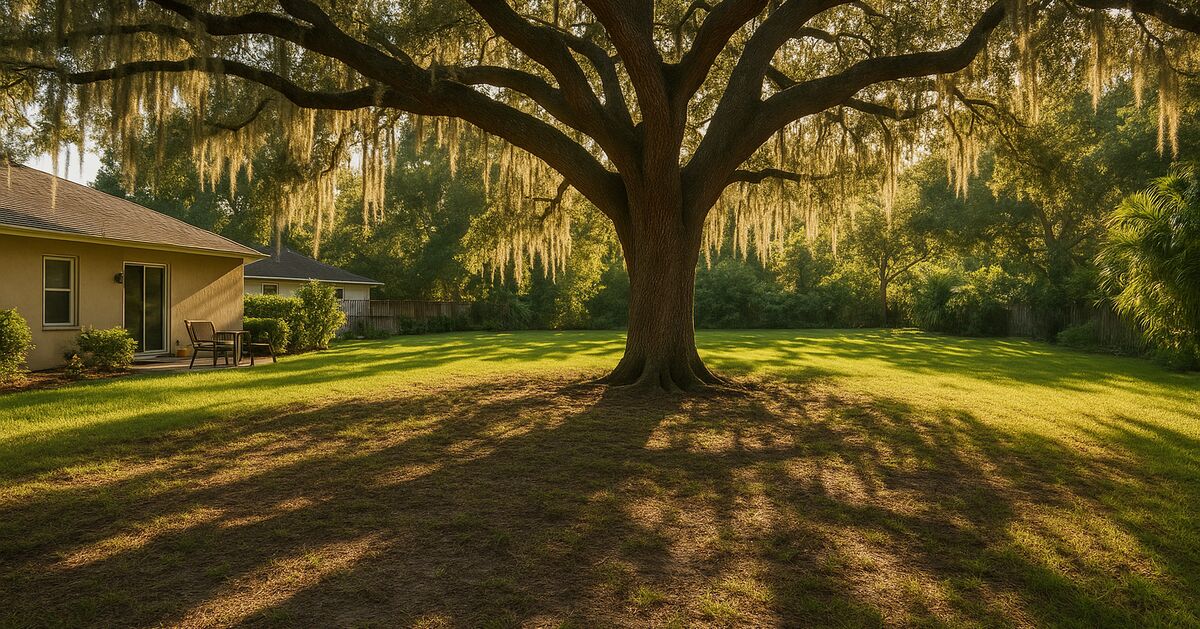
Shade is one of the most common reasons a Florida lawn starts losing ground, and one of the most misunderstood. Homeowners in Bradenton, Parrish, and Lakewood Ranch often assume the lawn is sick, dry, or infested when the real culprit is standing right above it, spreading branches across half the yard.
Understanding why grass struggles under oaks and palms, and what you can realistically do about it, will save you money, frustration, and a lot of wasted sod.
Why St. Augustine is Your Best Bet in Florida Shade (and Still Not Enough)
St. Augustine grass is the most shade-tolerant warm-season turf that performs reliably across Manatee County and the surrounding area. Varieties like Palmetto and Seville were specifically bred to handle reduced light. But "shade tolerant" does not mean "shade proof," and it is important to understand what that distinction means in practice.
St. Augustine needs a minimum of four hours of direct sunlight per day to survive, and ideally six or more to truly thrive. Below four hours, even the most shade-adapted variety will thin progressively over one to three growing seasons. The grass does not die overnight. It retreats. Blades grow longer and paler as the plant reaches for light it cannot find. The turf thins out, bare patches open up, and weeds and algae move in because the ground is moist, shaded, and no longer defended by a dense canopy of grass.
If you are watching this happen under a live oak or a cluster of palms in your yard, you are not imagining it, and you did not do anything wrong. It is simply the biology of the grass running up against the physics of light.
What Live Oaks Do to a Lawn Underneath Them
Live oaks are among the most beautiful and ecologically valuable trees in Florida. They are also, from a grass-growing standpoint, extraordinarily challenging neighbors. Here is what they do:
- Dense canopy coverage. A mature live oak spreads wide, sometimes 60 to 100 feet across, and its evergreen canopy blocks a significant portion of incoming sunlight year-round. Unlike a deciduous tree up north that lets winter sun through, a Florida live oak never goes bare.
- Surface root competition. Live oaks push a shallow, aggressive root system through the top few inches of soil, the exact zone where grass roots need to grow. Those tree roots compete directly with turf for water and nutrients, and they usually win. You may notice the lawn thinning first in the area directly over the root flare, then spreading outward.
- Leaf litter accumulation. Live oaks do shed leaves, just not all at once. They drop continuously throughout late winter and spring, and if those leaves mat down over the turf, they block light further and create humid conditions that invite fungal issues like [Take-All Root Rot]((/blog/take-all-root-rot-bare-patches-lawn)), which tends to show up first in shaded, stressed areas.
- Soil pH shifts. Oak leaf decomposition can gradually acidify the soil beneath the canopy. Slightly lower pH is not catastrophic, but it can affect nutrient availability and contribute to overall turf stress when combined with everything else going on under that tree.
What Palms Do Differently
Palms create a different kind of shade problem. Most palms, including sabal palms and the various ornamental species common across Anna Maria Island, Ellenton, and Palmetto neighborhoods, cast dappled, moving shade rather than the dense overhead canopy of a live oak. A single palm does not typically devastate turf on its own.
The challenge comes in clusters. A row of queen palms or a tight grouping of sabal palms can create overlapping shade patterns that add up to serious light reduction. Fallen fronds are another issue. A dropped frond lying on the grass will smother and bleach whatever is underneath it within a few days if left in place. Palm fronds also break down slowly and should be removed promptly rather than left to decompose on the turf.
Palm roots are also competitive but in a different way than oak roots. They tend to grow downward more deeply before spreading, so the surface competition is usually less severe. The primary problem with palms is almost always the light, not the root competition.
The Mistake Most Homeowners Make First
When the grass starts thinning under a big oak, the instinct is to replant. New sod goes in, looks good for a few weeks, then starts doing exactly what the old grass did. This cycle is discouraging and expensive.
Before you invest in new turf, assess the actual light level under the canopy honestly. Go outside at midday on a clear day and look at the ground under your oak. Is direct sunlight hitting the soil, or is it mostly shadow with occasional dappled light? If it is mostly shadow, new St. Augustine sod is not going to solve the problem. You will be back in the same place within a season or two. Our post on when to replace the lawn versus nurse it back walks through how to think about that decision honestly.
The second common mistake is over-fertilizing shaded areas hoping to push more growth. Shaded St. Augustine actually needs less nitrogen than turf in full sun. Heavy nitrogen in low-light conditions encourages lush, soft, elongated blades that are highly susceptible to fungal disease and insect pressure. Fertilize lightly and less frequently under tree canopies.
Canopy Thinning: The Option People Overlook
One of the most effective things you can do for shaded turf is to work on the tree rather than the grass. Selective canopy thinning by a certified arborist can meaningfully increase the amount of light reaching the ground without harming the tree or altering its character. Removing deadwood, crossing branches, and dense interior growth opens the canopy so that dappled light reaches the grass below.
This is not the same as topping or aggressively cutting back a tree. Proper canopy thinning respects the tree's structure. It typically makes the tree healthier and more wind-resistant, which matters a great deal for homeowners in Manatee County during hurricane season. A lighter canopy also reduces the volume of leaf litter dropping onto the turf.
Raising the canopy by removing lower limbs is another option. Lifting the tree's skirt allows more low-angle morning and afternoon light to reach the grass under and around the tree. This is particularly effective with live oaks, which tend to have sweeping lower branches that grow almost horizontally.
Realistic Grass Options for Shaded Florida Yards
Once you have done what you can with the tree and assessed the actual remaining light, here are your realistic turf options:
Palmetto St. Augustine is the most shade-tolerant St. Augustine variety and the first choice to try in marginal shade situations. It holds color and density better than Floratam in reduced light. If you have a moderately shaded area that gets four to five hours of direct sun, Palmetto St. Augustine is the grass to try.
Seville St. Augustine is another fine-bladed, shade-tolerant cultivar that performs well in partial shade. It is slightly more cold-sensitive than Palmetto, which is a minor consideration in most of Manatee County but worth noting if you are in a low-lying area that occasionally dips into the low 30s in January.
Zoysia is occasionally suggested as a shade alternative, but it is honestly not dramatically better than shade-tolerant St. Augustine in truly low-light conditions. Zoysia also recovers more slowly from damage and goes dormant and brown in winter, which many homeowners in this area find unacceptable. It is a fine grass for the right situation, but it is not a shade miracle.
Bahia is not a shade option. Bahia is a full-sun grass and will fail faster than Floratam St. Augustine in shaded conditions.
If you are curious about how these grasses compare across different site conditions, our lawn care and landscaping services page outlines what we look at when recommending the right grass for a specific yard.
When Grass Is No Longer the Right Answer
This is the honest part. In deep shade, meaning fewer than four hours of direct sun daily, no warm-season grass is going to give you a satisfactory result long-term. The grass will always be thin, stressed, and vulnerable. Continuing to replant turf in that spot is a recurring expense with no lasting payoff.
In those situations, the better investment is a ground cover or landscape bed. Options that work well under Florida oaks and palms include:
- Asiatic jasmine - a low, spreading ground cover that handles shade and competes well with surface tree roots.
- Liriope (monkey grass) - forms tidy clumps, handles deep shade, and is virtually indestructible in this climate.
- Bromeliads - suited to the dappled light common under palms and add color.
- Mulched beds - a well-maintained mulch bed under a canopy tree is not giving up. It is recognizing what the space needs and giving it that. It reduces soil moisture competition, protects shallow tree roots, and eliminates the frustration of watching turf fail repeatedly.
A mulch bed does not mean a weedy, neglected patch. Done properly, with the right depth and a refreshed top layer each year, a mulch ring around a mature oak can look genuinely elegant. Our team handles landscape bed installation and mulching for homeowners throughout Bradenton, Lakewood Ranch, and the surrounding communities if you want a professional opinion on what makes sense for your specific tree situation.
Managing the Transition Zone
The area right at the edge of the canopy, where partial shade transitions to more open sun, is actually manageable grass territory. This is the zone worth investing in. The turf here gets enough light to be competitive, but it needs some help because tree roots extend well beyond the canopy edge.
In this transition zone:
- Keep mowing height at 3.5 to 4 inches. Taller grass intercepts more light and builds deeper roots, both of which help it compete with tree roots.
- Water deeply but less frequently to encourage roots to go deeper rather than competing at the surface.
- Avoid heavy foot traffic in this zone. Shaded turf is less dense and recovers more slowly from compaction and wear.
- Apply a light, balanced fertilizer in spring and early summer, but skip the heavy fall nitrogen push that you might give your full-sun turf.
What to Expect If You Do Everything Right
Even with smart management, shade turf under a mature Florida oak will never look like the thick, dense lawn in the open part of your yard. Setting a realistic expectation matters. The goal under heavy canopy is decent coverage, not perfection. You are managing a challenging microenvironment, not a failure.
For homeowners across Parrish, Ellenton, and Palmetto who are dealing with this, know that you are in very good company. Mature tree canopy is one of the defining features of established Florida neighborhoods, and working with it gracefully is part of owning a home here.
If you want a second set of eyes on your specific shade situation, our team is happy to walk a property and give a straight assessment of what the grass can realistically do and where a different approach makes more sense. You can reach us through our contact page or browse our frequently asked questions for more detail on how we approach shade and other common lawn challenges across Manatee County.
Growing grass in shade is hard anywhere. In Florida, with live oaks that never drop their leaves and palm clusters that grow dense over time, it takes honest assessment and sometimes the willingness to work with the landscape rather than against it. The yards that look best under big trees are usually the ones where the homeowner stopped fighting the shade and started designing around it.