
Reading a fertilizer bag: what the three NPK numbers really mean
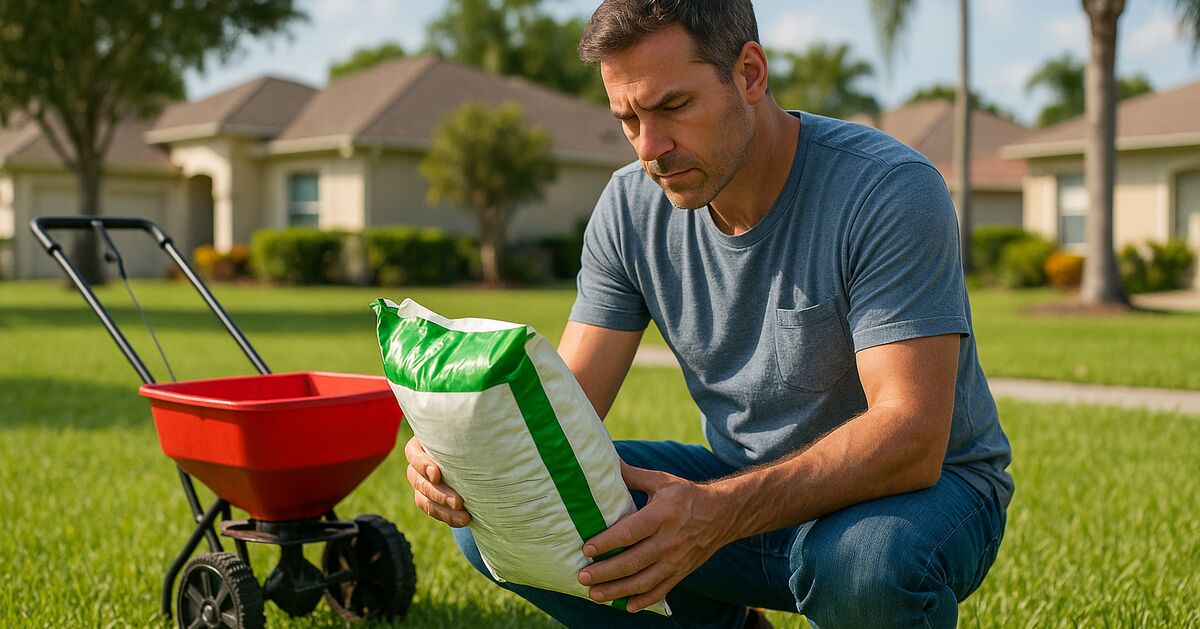
Those three bold numbers on the front of every fertilizer bag are not marketing. They are the single most useful piece of information on the package, and once you understand what they mean, you will never guess your way through the fertilizer aisle again.
Whether you are caring for a St. Augustine lawn in Bradenton, a Bahia pasture-style yard in Parrish, or a manicured Zoysia lawn in Lakewood Ranch, the NPK ratio is where every good fertilizer decision starts.
What NPK stands for
NPK is shorthand for the three primary nutrients in any complete fertilizer:
- N - Nitrogen
- P - Phosphorus
- K - Potassium
The numbers on the bag tell you the percentage by weight of each nutrient inside. A bag labeled 16-0-8, for example, contains 16% nitrogen, 0% phosphorus, and 8% potassium. A 50-pound bag of that product delivers 8 pounds of actual nitrogen, zero pounds of phosphorus, and 4 pounds of actual potassium. Everything else in the bag is filler material, called "carriers," that help spread the product evenly.
That percentage system is standardized by federal law, so a 16-0-8 from one brand delivers the same nutrient load as a 16-0-8 from any other. The ratio is the recipe. The brand is just the label.
What each nutrient actually does
Understanding the job of each nutrient helps you match the product to what your lawn is actually missing, rather than just grabbing whatever is on sale.
Nitrogen (the first number)
Nitrogen is the growth and color nutrient. It drives the production of chlorophyll, which is what makes grass green, and it fuels the leaf and shoot growth you see above ground. When a lawn looks pale, yellow, or just tired, low nitrogen is usually the first suspect.
Nitrogen is also the nutrient that leaches most easily out of Florida's sandy soils. Rain moves it downward, often below the root zone before the grass can absorb it. That is why Florida lawns generally need several smaller nitrogen applications across the year rather than one heavy feeding, and it is part of why slow-release (or "controlled-release") nitrogen sources appear on so many Florida-recommended fertilizers. The slow-release fraction feeds the lawn gradually over weeks instead of dumping everything at once.
A high first number is what you reach for when you want to green things up or push recovery after stress. But more is not always better: too much nitrogen in one shot encourages lush, soft growth that is more attractive to pests and disease, and excess nitrogen that is not absorbed runs off into waterways.
Phosphorus (the middle number)
Phosphorus supports root development, seed germination, and the energy transfer processes inside the plant. It is critical when you are establishing new sod or planting from seed, because young roots need it to get established.
Here is the important Florida-specific point: most established Florida lawns do not need additional phosphorus at all. Our soils, particularly in Manatee County and the surrounding area, already hold adequate phosphorus for mature turf. Applying more phosphorus to an established lawn does not produce greener grass or thicker turf; it just adds nutrient load to a system that does not need it, and that excess phosphorus can eventually reach ponds, lakes, and coastal waters where it feeds algae blooms.
This is a big reason why products with a zero in the middle position, like 15-0-15 or 16-0-8, are so common in Florida lawn care recommendations. Many county extension offices and water management districts actively encourage homeowners to choose phosphorus-free fertilizers for established turf. If you are laying new sod and nursing it through the critical first weeks, a small amount of phosphorus in a starter fertilizer can help root establishment. For everything else, skip the middle number.
Potassium (the third number)
Potassium is the stress-tolerance nutrient. It helps grass handle drought, heat, cold snaps, disease pressure, and foot traffic. Think of it as the nutrient that helps grass toughen up rather than just grow fast.
In Southwest Florida, potassium is genuinely important. Our summers push grass hard: intense heat, heavy rain, high humidity, and the threat of fungal disease all take a toll. Lawns with adequate potassium handle that stress better and recover more quickly. Sandy soils also tend to be naturally low in potassium because it leaches fairly easily, so regular replenishment makes sense.
A higher third number is often what you want when you are heading into summer stress season or coming out of a rough patch. Many Florida-specific fertilizers are formulated with a high potassium ratio for exactly this reason.
Why the ratio matters more than the numbers alone
Here is something that trips up a lot of homeowners: a 10-0-10 and a 20-0-20 have the same ratio of nitrogen to potassium (1:1), but the 20-0-20 delivers twice as much of each nutrient per pound of product. The ratio tells you the balance; the application rate on the bag tells you how much product to use to hit the right amount of actual nutrient per 1,000 square feet.
When you see a fertilizer labeled for Florida or for "warm-season grasses," look for these general characteristics:
- A moderate to high first number (nitrogen), ideally with a significant slow-release fraction (look for "slow-release N" or ingredients like sulfur-coated urea, polymer-coated urea, or IBDU on the label)
- A zero or very low middle number (phosphorus) for established lawns
- A solid third number (potassium), often at roughly half the nitrogen rate or equal to it
A product like 15-0-15 or 24-0-11 with slow-release nitrogen fits that profile well for most established Florida lawns.
Reading beyond the three numbers
The NPK is the headline, but the full label has more to tell you.
Secondary nutrients and micronutrients. Look for iron, manganese, magnesium, and sulfur. Florida's alkaline soils can make iron and manganese hard for grass to absorb even when they are present, causing a yellowing condition called iron chlorosis. A fertilizer that includes chelated iron can help keep St. Augustine looking dark green without pushing excessive growth.
Slow-release percentage. Florida's water management districts often recommend that at least 30% of the nitrogen in any fertilizer be slow-release. Many quality products go higher, up to 50% or more. This information is usually listed on the guaranteed analysis panel, not just the front of the bag.
Filler and carrier material. The rest of the bag is not wasted. Good carriers help the product spread evenly through your spreader and improve consistency of coverage.
How to pick the right fertilizer for your specific situation
Use this as a simple guide:
Established St. Augustine lawn, general maintenance: Look for a slow-release formulation with a zero or near-zero middle number. Something in the 15-0-15, 16-0-8, or similar range works well. Apply at the rate that delivers no more than 1 pound of actual nitrogen per 1,000 square feet per application.
Established Bahia lawn: Bahia is a lower-maintenance grass and does not need heavy feeding. A moderate-nitrogen, phosphorus-free product applied two to three times per year is usually plenty. Bahia is more drought-tolerant but still benefits from potassium during stress periods.
Established Zoysia lawn: Zoysia is denser and slower-growing, so it can be over-fertilized easily. Fewer applications, a moderate nitrogen rate, and good potassium support work well. Avoid pushing it with high-nitrogen products during summer, when fungal pressure is already high.
New sod installation: A starter fertilizer with some phosphorus (a non-zero middle number) is appropriate for the first application to support root establishment. After the lawn fills in, switch to a standard phosphorus-free maintenance product. Our post on what to expect in the first weeks after new sod is installed covers the early care timeline in detail.
Coming out of a stressful period (drought, pest damage, disease): After recovery from something like brown patch fungus or gray leaf spot, a light nitrogen application with higher potassium can help the lawn rebuild. Do not rush high-nitrogen feeding right after a disease event; let the lawn stabilize first.
Timing: when to fertilize in Manatee County
Even the right fertilizer does the wrong thing if you apply it at the wrong time. Florida has specific rules and good-sense guidelines worth knowing.
Manatee County, like many Florida counties, enforces a summer fertilizer blackout period (roughly June through September) when applying nitrogen and phosphorus fertilizers to lawns is restricted. The goal is to reduce nutrient runoff during the heavy summer rain season, when products are most likely to wash off before the grass can absorb them. Our full services page and the FAQ cover the seasonal timing questions we hear most often.
Outside the blackout window, the best times to fertilize in our area are:
- Early spring (March to April): As the grass is breaking dormancy and actively growing, this is the most responsive time for nitrogen.
- Late spring (May to early June): A second application before the blackout period can set the lawn up for summer.
- Early fall (October): After the blackout ends, a balanced feeding helps the lawn recover from summer and build root reserves heading into the cooler months.
- Late fall (November): A light potassium-heavy application can help St. Augustine handle the occasional cool snap we get across Ellenton, Palmetto, and Anna Maria Island.
Always water the fertilizer in after application, ideally within 24 hours, to move the product off the leaf blades and into the soil where the roots can reach it. Do not fertilize before a heavy rain is forecast because runoff is a real risk.
Common mistakes homeowners make
Doubling up "just to be sure." Applying more fertilizer than the bag recommends does not double the benefit; it often causes fertilizer burn, promotes the kind of soft, fast growth that attracts chinch bugs and disease, and wastes money. Follow the rate on the bag.
Ignoring the slow-release fraction. A cheap fertilizer with all fast-release nitrogen gives you a quick green flush and then fades fast. It also risks burning the lawn in summer heat. Look for slow-release sources on the ingredients list.
Using the same product for every situation. A bag marketed as "all-purpose" or "garden fertilizer" may have a high phosphorus number that is wrong for an established Florida lawn. Read the analysis, not just the front-label marketing.
Forgetting the spreader calibration. An uncalibrated spreader can deliver two or three times the intended rate in some strips and almost nothing in others. Striped lawns after fertilization are almost always a spreader problem. Take five minutes to calibrate your rotary or drop spreader to the setting listed on the bag.
Fertilizing dormant or stressed grass. If your lawn is dormant, drought-stressed, or in the middle of a disease outbreak, it cannot effectively absorb fertilizer. Wait until the lawn is actively growing and healthy before feeding it.
When it makes sense to get a soil test
If your lawn consistently looks off despite regular care, a soil test from the UF/IFAS extension service can tell you exactly what is abundant, what is deficient, and what the pH is doing. Soil pH affects nutrient availability significantly: in very alkaline soils, iron and manganese become harder to absorb even if they are physically present. A test removes the guesswork and lets you correct the actual problem instead of throwing products at a symptom.
Our team at Manatee Lawn Care works with homeowners across the area on exactly these kinds of questions, from simple fertilizer timing to full lawn health assessments. If you would like a professional eye on your turf before your next fertilizer application, you can reach out to us here. We serve homeowners throughout Bradenton, Lakewood Ranch, Palmetto, Parrish, Ellenton, and Anna Maria Island, and we are happy to walk through what your specific lawn needs this season.
Understanding the three numbers on the bag is not complicated once you see what each nutrient is actually doing for the plant. Nitrogen feeds growth and color, phosphorus supports roots and establishment, and potassium builds resilience. Match the ratio to your situation, choose a slow-release source, respect the application rate, and time it right for our Florida seasons. Your lawn will respond in a way that makes the choice obvious.