
The Right Mowing Height for St. Augustine Grass in
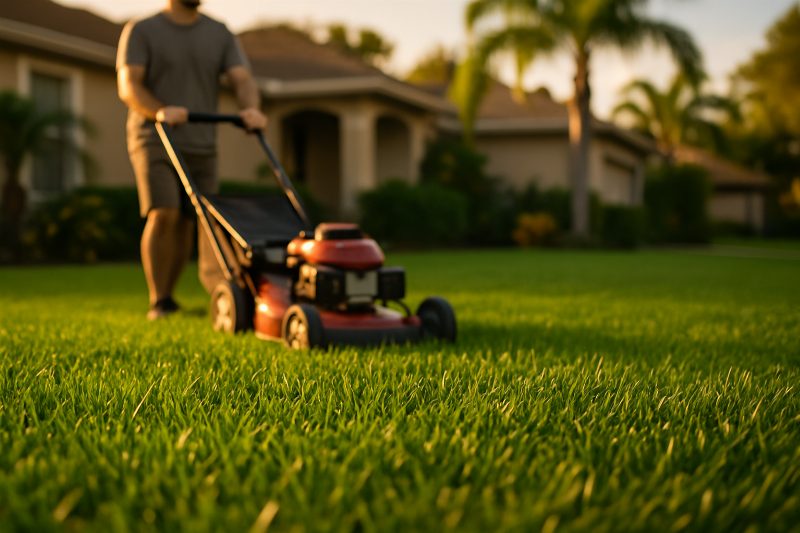
Getting the mowing height wrong is the single most common reason St. Augustine lawns in Southwest Florida go from lush and green to thin, weedy, and patchy - often within just a few weeks.
It sounds like a small detail. It is not. Blade height controls how much sunlight reaches the soil, how deep your grass roots grow, how well your lawn handles drought, and how easily fungal diseases and pests get a foothold. Nail the height, and almost everything else about lawn care gets easier. Ignore it, and you can spend a lot of money on fertilizer, weed killers, and irrigation trying to fix problems that never needed to start.
Here is everything you need to know about mowing height for St. Augustine grass, written specifically for the conditions we deal with in Bradenton, Lakewood Ranch, Parrish, Palmetto, Ellenton, and Anna Maria Island.
The Short Answer: 3.5 to 4 Inches
St. Augustine grass in Southwest Florida should be maintained at 3.5 to 4 inches in height. That is the blade length after you mow, not before.
Some sources suggest as low as 2.5 inches is acceptable, and technically the grass will survive at that height. But "survive" is not the same as "thrive." In our climate, with our intense summer sun, high humidity, and heavy rain followed by dry spells, keeping St. Augustine on the taller end of its range gives it a significant advantage.
At 3.5 to 4 inches:
- The longer blades shade the soil surface, keeping it cooler and reducing moisture evaporation between rain events.
- Weed seeds that land on the soil get far less sunlight, which slows germination dramatically.
- The grass plant can support a deeper, more extensive root system because photosynthesis capacity is higher.
- The lawn looks denser and more uniform, because you are cutting less of each individual blade each time you mow.
Drop below 2.5 inches and you are scalping the lawn. You will see it immediately: the grass turns yellowish-brown as you expose the older, lower stems that have little to no chlorophyll. Recovery is slow, and while the lawn is stressed, every pest and disease organism in the neighborhood takes notice.
Why Southwest Florida's Climate Changes the Equation
Mowing recommendations are not universal. What works for St. Augustine grass in Jacksonville or Tallahassee is not automatically right for Manatee County. A few things about our local environment push the ideal height toward the taller end of the range.
Heat intensity. Bradenton and the surrounding area regularly sees heat indices above 100°F from May through September. Tall grass blades shade the crown of the plant and the root zone, acting as a natural insulator. A lawn mowed to 3 inches versus 4 inches may not look dramatically different to your eye, but the soil temperature difference underneath can be several degrees - enough to matter for root health.
Sandy soil. Much of Manatee County sits on sandy, fast-draining soil that dries out quickly between rain events. Taller grass reduces surface evaporation and helps the lawn go longer between irrigation cycles. That matters both for your water bill and for the resilience of the turf during summer dry spells.
Fungal pressure. Warm temperatures plus high humidity is the exact recipe that fungal diseases love. [Gray leaf spot](blog/gray-leaf-spot-summer-fungus-st-augustine-grass), for example, is a genuine threat to St. Augustine lawns here from June through September. Stressed, scalped grass is far more vulnerable to infection than healthy grass mowed at the proper height. Keeping your lawn thick and vigorous through correct mowing is one of the cheapest forms of disease prevention available.
Pest pressure. Chinch bugs are one of the most destructive pests we see on St. Augustine grass in this area. Lawns that are regularly scalped or mowed too short tend to have thinner, weaker turf that chinch bugs can devastate in a matter of weeks. If you have ever wondered whether a dry-looking patch is pest damage or just drought stress, our guide on chinch bugs vs. drought stress in St. Augustine grass walks through the difference in detail.
The One-Third Rule: Why It Matters More Than You Think
Knowing the target height is only half the equation. The other half is understanding the one-third rule: never remove more than one-third of the blade length in a single mowing.
Here is why this matters in practical terms. If your target height is 4 inches, you should mow when the grass reaches about 5.5 to 6 inches. Cutting it back to 4 inches removes roughly one-third of the blade. That is within the zone where the grass can recover quickly without significant stress.
If you let the lawn grow to 8 inches and then mow it back to 4, you have removed half the blade. The grass goes into shock. Root development pauses. The lawn looks rough and uneven for days. And because you had to cut so deep to get to your target height, you likely exposed some of those older, paler stem sections that make the lawn look brown and scalped.
Violating the one-third rule occasionally will not kill your lawn. Doing it repeatedly, especially during the summer heat, can thin the turf enough to give weeds and fungal diseases a genuine opening.
The practical takeaway: mow more frequently during the growing season, less frequently during cooler months. In a typical Manatee County summer, St. Augustine grass may need mowing every five to seven days. In the winter months from December through February, that might stretch to every two to three weeks.
Seasonal Adjustments That Make Sense Here
Southwest Florida does not have dramatic seasons the way northern states do, but we do have meaningful differences between summer and winter that should influence how you manage your mowing height.
Summer (May through October): Stick to the taller end of the range, 3.5 to 4 inches. The grass is actively growing, which means it can tolerate and benefit from the extra leaf area. The heat and sun are intense, so the shading effect of taller blades is especially valuable.
Winter (November through April): You can bring the height down slightly, toward 3 to 3.5 inches, if you prefer a neater appearance. Growth slows considerably, so you are not stressing the plant by removing more proportionally. However, do not drop below 3 inches. Even in our mild winters, the grass needs enough leaf area to handle any unexpected cold snaps and to come back strong in spring.
Transitioning in and out of summer: Raise your mower deck gradually as temperatures climb in April and May. Drop it gradually as temperatures moderate in October and November. Sudden shifts in height stress the grass unnecessarily.
Common Mistakes We See All the Time
After years of working on lawns across Bradenton, Lakewood Ranch, Parrish, and the surrounding communities, we see the same mowing mistakes repeated over and over.
Mowing too short to reduce mowing frequency. The logic makes sense on the surface: cut it short and you won't have to mow as often. In practice, it backfires badly. Scalped grass grows back more slowly, looks terrible, and requires intervention you would not have needed otherwise. It also invites nutsedge and other weeds that thrive in thinned-out turf. If nutsedge is already a problem in your yard, our post on how to get rid of nutsedge in a Florida lawn is worth a read.
Using dull mower blades. A dull blade tears the grass instead of cutting it cleanly. The frayed tips turn tan or brown within a day or two, making the whole lawn look like it has disease or drought stress. Sharpen your blades at least once a season, and ideally every 8 to 10 hours of mowing time. This one change has a visible impact on how your lawn looks after each cut.
Mowing wet grass. It is tempting to mow as soon as the rain stops, especially when the grass has shot up during a summer growth flush. Wet grass clumps, clogs your mower deck, and leaves uneven clumps of clippings on the lawn that can smother the turf underneath. Wait until the grass is dry enough that the blades stand upright.
Scalping before winter. Some homeowners scalp their St. Augustine lawn in the fall, thinking it will help the grass come back cleaner in spring. It does not. It removes the energy reserves the plant needs to stay healthy through the cooler months and bounce back in spring. If your lawn has a thatch problem, address it properly with dethatching rather than scalping.
Changing height too drastically at once. If your lawn has been mowed short for a while and you want to bring it up to 4 inches, do it over two or three mowing cycles rather than all at once. Let the grass adjust gradually.
What About Shade Areas?
St. Augustine is one of the more shade-tolerant warm-season grasses, which is part of why it dominates Florida lawns. But in shaded areas under trees or along the north side of structures, it does benefit from being mowed slightly taller, toward 4 inches. The longer blades maximize the limited light available, helping the grass stay competitive and dense rather than thinning out.
If a section of your lawn is receiving less than four hours of direct sunlight per day, even proper mowing height may not be enough to keep St. Augustine dense. That is worth a conversation about alternative ground covers or landscaping adjustments. Our team is happy to walk through those options with you.
When Something Still Goes Wrong
Even with perfect mowing practices, Southwest Florida lawns face challenges that mowing height alone cannot prevent. Bare patches that refuse to fill in might point to take-all root rot, a soil-level fungal disease that affects roots directly. Tunneling damage through your lawn could mean mole crickets are working below the surface. And fire ants can quickly become a lawn-wide problem if populations are not managed. Our guide on fire ant control for Manatee County yards covers the approaches that work without harming your turf.
The point is that mowing at the right height puts your lawn in the best possible position to handle these challenges, but it works as part of a broader care routine, not in isolation.
Getting Consistent Results
The best results come from consistency. Mowing at the right height, on the right schedule, with sharp blades, and never removing more than one-third of the blade at a time will produce a noticeably healthier, better-looking lawn than one mowed at the wrong height even with fertilizer and irrigation doing their jobs properly.
If keeping up with a weekly or near-weekly summer mowing schedule is not realistic for your household, that is completely understandable. Manatee County summers are hot, and life gets busy. Our lawn care and landscaping services are designed around exactly this kind of consistent, schedule-based maintenance. We handle the mowing so you do not have to think about it.
You can also check our frequently asked questions for quick answers on mowing schedules, blade height adjustments for different grass conditions, and other common lawn care topics. Or, if you're ready to talk about what your specific lawn needs, reach out to us directly. We serve homeowners across Bradenton, Lakewood Ranch, Palmetto, Parrish, Ellenton, and Anna Maria Island, and we are happy to take a look and give you an honest assessment.
Your lawn is one of the largest surfaces around your home. Getting the mowing height right is the simplest, cheapest, and most impactful thing you can do to keep it looking its best.