
Crabgrass and the pre-emergent timing window in Southwest Florida
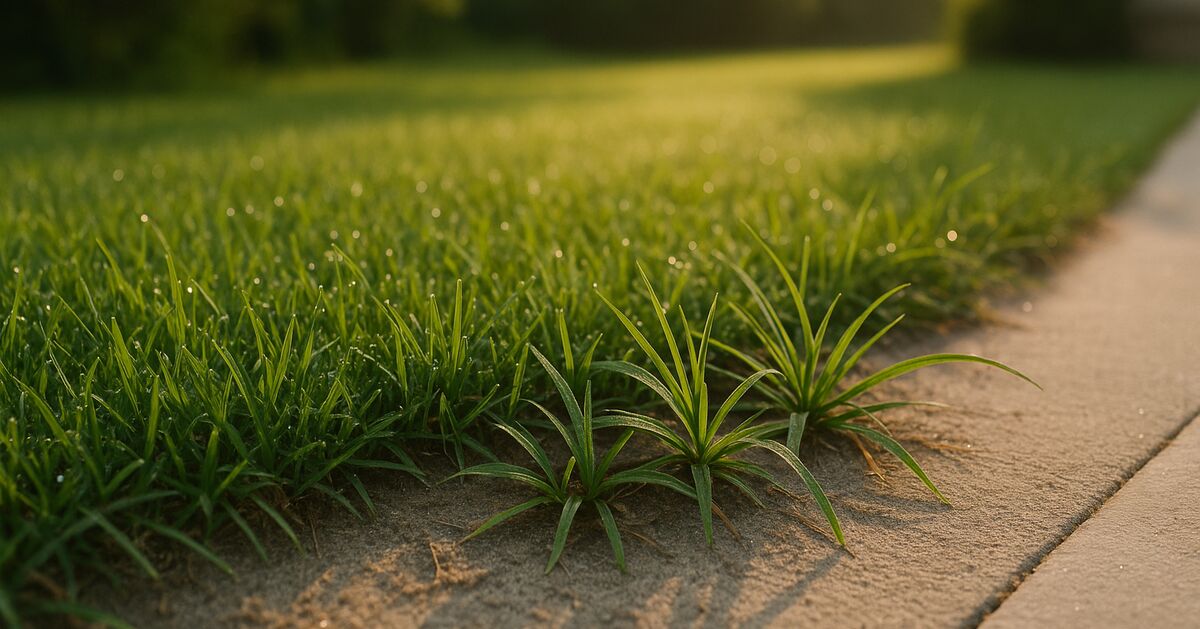
Crabgrass does not ask permission. One week your lawn looks clean and even, and the next you have wide, coarse clumps spreading outward in every direction, stealing sunlight, water, and nutrients from your St. Augustine or Bahia turf. The only reliable way to stop it is before it ever breaks the soil surface, and that means understanding the narrow pre-emergent window that Southwest Florida gives you every year.
That window is shorter, earlier, and less forgiving than almost anywhere else in the country. Get it right and you'll spend the rest of the year enjoying a clean lawn. Miss it by even a couple of weeks and you'll be chasing crabgrass with post-emergent herbicides all summer long, which is harder, more expensive, and far less effective.
What crabgrass actually is and why it thrives here
Crabgrass (most commonly Digitaria sanguinalis and Digitaria ischaemum in our area) is a warm-season annual grassy weed. "Annual" is the key word. It germinates from seed, grows aggressively through the warm months, sets hundreds of new seeds before it dies, and then starts the whole cycle over again the following year. Every plant that matures in your lawn leaves behind a seed bank that can stay viable in the soil for several years.
Southwest Florida's climate is almost purpose-built for crabgrass. We have long, hot summers, consistently warm soil temperatures, and the rainy season delivers exactly the moisture crabgrass needs to explode once it germinates. Lawns in Parrish, Palmetto, and the more open neighborhoods of Lakewood Ranch that have a lot of sun exposure are especially vulnerable because crabgrass is a full-sun opportunist. It struggles in dense shade, which is one reason you tend to see it worst along driveways, sidewalk edges, and thin or stressed turf areas where the canopy has opened up.
How pre-emergent herbicides work
A pre-emergent herbicide does not kill seeds. This is one of the biggest misconceptions homeowners have. It creates a chemical barrier in the upper layer of the soil that disrupts cell division in a germinating seedling, preventing it from establishing a root system and emerging. Once a weed has already sprouted and you can see it with the naked eye, a pre-emergent does nothing to it. That's why timing is everything.
Common active ingredients you'll find in pre-emergent products labeled for Florida lawns include pendimethalin, prodiamine, dithiopyr, and isoxaben. Each has slightly different residual lengths and label restrictions, so always read the label carefully before applying, especially if you have recently laid new sod or are planning to seed. Our lawn care and landscaping services team uses products matched to the specific turf type and the season, which matters more in Florida than people realize.
The Southwest Florida timing window: earlier than you think
Most national gardening guides tell homeowners to apply pre-emergents "when soil temperatures reach 55 degrees Fahrenheit at a 4-inch depth for several consecutive days." That's correct science. The problem is that in Manatee and surrounding counties, the soil rarely spends much time near 55 degrees. Our winters are mild and brief, which means soil temperatures climb back into crabgrass-germination range much sooner than in Georgia, the Carolinas, or the Midwest.
In practice, the first pre-emergent application window for crabgrass in our area typically falls between mid-January and mid-February. Some years, if January is particularly warm (which is not unusual along the coast from Anna Maria Island through Palmetto), you may need to act closer to the first week of February at the latest. Waiting until March, as many national resources suggest, means you have almost certainly already missed the window for the first germination flush.
Here is a simple rule of thumb for our area: when you see the first wild bittercress or other early spring weeds starting to bloom in your landscape beds, the soil is warming fast and your window is either open right now or already closing.
A second application is almost always warranted. Pre-emergents break down over time due to our heat, UV exposure, and irrigation. A product with good residual control might hold for 8 to 12 weeks under normal conditions, but Florida's intense sun and summer rainfall can push it toward the shorter end of that range. A second application roughly 8 to 10 weeks after the first, typically in late March or early April, helps close off the second germination flush that arrives with the early rainy season buildup.
Soil temperature: how to actually track it
You do not have to guess. The University of Florida's Florida Automated Weather Network (FAWN) publishes soil temperature readings from stations around the state. There is a station in the Myakka area that gives a reasonable read for inland Manatee County communities like Parrish and Ellenton. Coastal areas near Bradenton and Anna Maria Island often run a few degrees warmer in winter due to the moderating influence of the Gulf and Tampa Bay.
A soil thermometer from any garden center works fine too. Push it to a 4-inch depth in a sunny, representative part of your lawn in the morning. Do this on several consecutive days. When you are consistently reading above 50 to 55 degrees, crabgrass germination is either happening or about to start.
Common mistakes that kill your pre-emergent's effectiveness
Applying too late. This is the single most common error. By late February or early March in a typical Southwest Florida year, some crabgrass has already germinated. You are already behind.
Mowing or disturbing the soil right after application. Pre-emergents need to be watered in and then left alone to form that chemical barrier. Aggressive mowing, aerating, or heavy raking shortly after application can physically disrupt the barrier and create gaps where weeds will push through.
Skipping irrigation after application. Most pre-emergent products need about a quarter to a half inch of water to activate and move into the soil profile. If you apply and then get two weeks of dry weather without running your irrigation system, the product just sits on top of the thatch layer doing very little. Check your irrigation schedule and review whether your system is set up to actually water things in correctly. If you are unsure about your watering days and amounts, the SWFWMD watering rules post is worth reading before your next application.
Using the wrong product for your turf type. Not all pre-emergents are safe on all grass types. Some products that work fine on Bahia or Zoysia can stress St. Augustine, especially at higher rates. Always confirm your grass type and check the label's approved turf list.
Relying on pre-emergent alone while the lawn is thin. A dense, healthy turf canopy is your first and best defense against any weed. Crabgrass is an opportunist. It moves into bare spots, thin edges, and stressed areas. If your lawn has significant bare patches, pre-emergent chemistry alone will not save you. You may also need to look at whether your turf can be rehabilitated or whether larger repairs are in order. The post on how to tell whether you should replace or nurse your lawn back can help you work through that decision.
What to do if you've already missed the window
If it's already late February or later and you can see crabgrass seedlings, you have two realistic options.
First, post-emergent herbicides. Products containing quinclorac or fenoxaprop are labeled for crabgrass control in warm-season turf. They work on young plants more effectively than mature ones, so the sooner you apply after you spot germination, the better your results. Multiple applications are usually needed. Be patient, these products often take 7 to 14 days to show visible results, and they are harder on young or stressed turf.
Second, accept some pressure this season and invest in doing the pre-emergent program correctly next winter. Combine that with keeping the lawn as thick and healthy as possible through proper mowing, fertilization within Manatee County's seasonal rules, and appropriate irrigation. A dense St. Augustine canopy will shade out a meaningful percentage of crabgrass before it can get established. For guidance on keeping nutrients in the right range even when the summer fertilizer ban is in effect, the post on greening up your lawn with iron during the fertilizer ban is a good companion read.
Local factors worth knowing by neighborhood
In Bradenton and Ellenton, many properties have older lawns with significant thatch buildup. Thick thatch can actually intercept a pre-emergent before it reaches the soil, reducing effectiveness. If your thatch layer is more than about three-quarters of an inch thick, light dethatching or verticutting in late fall before the pre-emergent application season can improve product penetration dramatically.
In Lakewood Ranch, newer construction communities often have thin, young sod that is still filling in. Young sod means gaps in the canopy, and gaps mean crabgrass opportunity. Pre-emergent timing is especially critical in these areas, but always confirm that your sod is established enough before applying (generally at least 6 to 8 weeks post-installation, and only after it has rooted and been mowed at least twice).
On Anna Maria Island and along the coastal edges of Palmetto, salt spray, sandy soils, and slightly warmer winter temperatures mean crabgrass pressure can arrive even earlier. Homeowners in these areas should be watching their soil temperatures in January and not waiting until February to make a decision.
If you are in Parrish, the more rural and open character of many lots means more sunlight reaching the lawn and often larger areas of exposed soil along property edges and fence lines. Those edge zones are where crabgrass typically gets its first foothold before migrating inward, so pay special attention to perimeter application coverage.
You can see all the communities we work in on our service locations page. No matter where you are in Manatee County and the surrounding area, the pre-emergent timing principles above apply, just weighted slightly toward earlier action the closer you are to the coast.
A realistic annual schedule for crabgrass prevention
Here is what a solid pre-emergent program looks like in our area, condensed into a calendar:
- January (mid to late): Apply first pre-emergent application once soil temps are consistently approaching 55 degrees. Water in within 24 to 48 hours.
- March to early April: Apply second pre-emergent application to extend coverage through the early rainy season germination window.
- May onward: Scout for any breakthrough. If you see young crabgrass, apply a post-emergent quickly while plants are small.
- Summer: Focus on turf health. Thick, well-mowed, appropriately fertilized turf competes with weeds. Review our complete lawn care services if you want a professional managing this cycle for you.
- Fall: Do not neglect the lawn heading into winter. A healthy, dense turf entering the cool months is better positioned to compete with early spring weeds. The fall lawn care checklist for Southwest Florida homeowners is worth bookmarking.
The bottom line
Crabgrass is not a weed you fight in June. You fight it in January and February, before it ever wakes up. Southwest Florida's mild winters mean the soil warms early, the window opens early, and it closes before most national gardening calendars even mention it. Mark your calendar now, track your soil temperatures, and get that first application down on time.
If you would rather hand this off to someone who tracks these windows every year, get in touch with us and we can walk you through a weed management program matched to your turf type and property. A clean lawn is a lot easier to maintain than a weedy one is to rescue.