
SWFWMD watering rules: how many days a week you can actually water
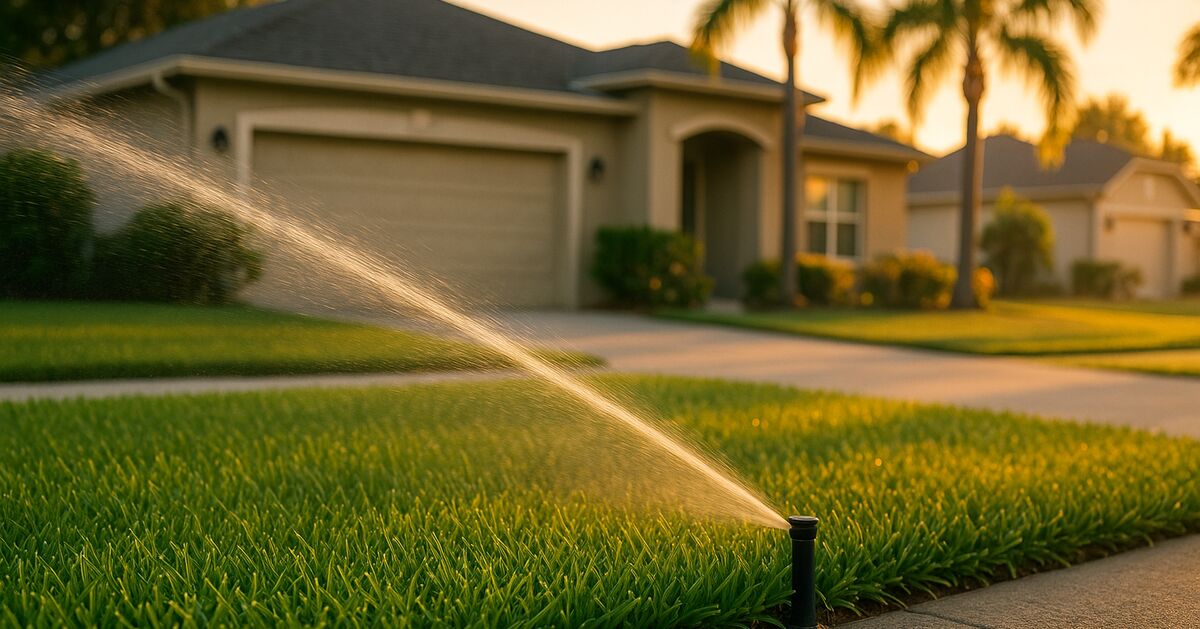
Your sprinkler timer is probably set wrong, and you may not even know it.
The Southwest Florida Water Management District (SWFWMD, often called "Swiftmud" locally) sets mandatory watering restrictions across its territory, which covers all of Manatee County, including Bradenton, Lakewood Ranch, Palmetto, Parrish, Ellenton, and Anna Maria Island. These aren't suggestions. Violating them can result in a warning, a fine, or your irrigation permit being pulled. Yet a surprising number of homeowners are running their systems on the wrong days or at the wrong times simply because nobody ever explained the rules in plain language.
This post covers exactly how many days per week you're allowed to water, which days those are based on your address, what time of day you must finish by, the exceptions that apply, and the honest lawn care implications of living under these limits.
The baseline rule: two days a week, period
Under SWFWMD's year-round landscape irrigation rule, most residential properties are restricted to two designated days per week. That applies to automatic in-ground sprinkler systems, traveling sprinklers, and any irrigation device that isn't you standing there holding a hose. It does not matter what time of year it is or how dry the weather has been. Two days is the standard allowance for the overwhelming majority of homes in Manatee County.
This is stricter than many homeowners assume. If you moved here from another part of the country, you may have been used to watering whenever the lawn looked a little stressed. That approach isn't legal here, and for good reason: Southwest Florida's freshwater supply relies on the same aquifer system everyone draws from, and landscape irrigation accounts for a massive share of residential water use.
Your specific days depend on your address
SWFWMD assigns watering days based on the last digit of your street address. Here's how it breaks down for most residential properties:
- Even-numbered addresses (0, 2, 4, 6, 8): Water on Thursday and Sunday
- Odd-numbered addresses (1, 3, 5, 7, 9): Water on Wednesday and Saturday
Those are your two days. Not two days of your choosing. The district assigns them so that not everyone is pulling from the system at the same time.
If you live in a community with a homeowners association or a reclaimed water system, the rules may differ slightly. Some communities in Lakewood Ranch, for example, use reclaimed water for irrigation and operate under separate district permits with their own assigned days. Check with your HOA or utility provider if you're unsure which rules apply to your property. Our lawn care and landscaping services in Lakewood Ranch often come up against this question, so it's worth a quick call to confirm before assuming you follow the standard schedule.
The time-of-day rule matters just as much
Knowing your days is only half the compliance puzzle. SWFWMD also restricts when during those days you can water. The rule is straightforward: no irrigation between 10 a.m. and 4 p.m.
The reasoning is practical. Watering in the heat of the day means a large portion of what you apply simply evaporates before it ever reaches the root zone. You're wasting water and not actually helping your lawn. The district's restriction pushes watering into the early morning hours, which is also better for the grass. Running your system between 2 a.m. and 8 a.m. on your assigned days is ideal: pressure is high, wind is low, and the lawn has time to absorb moisture before the sun climbs.
Avoid watering in the evening if you can help it. While the district doesn't prohibit late-evening irrigation (as long as it falls outside that 10 a.m. to 4 p.m. window), wet turf sitting overnight is an open invitation to fungal disease. Brown patch, gray leaf spot, and take-all root rot all thrive in lawns that go to bed wet. The watering restriction schedule and good lawn health point you in the same direction: water early in the morning.
What does NOT count as irrigation
The district's rules specifically target automated irrigation systems and mechanical irrigation devices. Hand watering with a handheld hose or a hand-held container is not restricted by day or time. So if you've just planted a flat of new annuals or you notice a dry spot that desperately needs attention on a non-irrigation day, you can walk out there with a hose and address it. You just can't send your sprinkler system out to do the same job.
Micro-irrigation systems (drip lines and soaker hoses delivering water directly to plant roots) are also treated differently in some contexts, though they are still subject to local utility rules in many communities. Check with your water provider if you're running drip irrigation on a separate zone.
Exceptions: new sod and seeded areas
The single biggest exception to the two-day rule is newly installed sod or seeded areas. SWFWMD allows a 30-day establishment period during which you can water every day. This makes complete sense, because freshly laid sod doesn't have an established root system yet and genuinely cannot survive on two waterings a week during a hot Florida summer.
After those 30 days, you must drop back to your assigned two-day schedule. Many homeowners miss this transition point, either continuing to water daily out of habit or because their installer never mentioned it. If you've had new sod put down and you're past the 30-day window, your timer needs to be adjusted now.
We've written in depth about what happens in those critical first weeks after installation. If your new turf is struggling, new sod turning brown covers the first three weeks in detail and explains what's normal versus what signals a real problem.
There's also a provision for plant establishment after other types of landscaping installations, such as newly planted trees and shrubs. Those can be hand-watered as needed during establishment without violating irrigation restrictions, since hand watering is exempt.
What about drought or water shortage orders?
SWFWMD can tighten restrictions further during declared water shortages. During a Phase 1 shortage, you're still on two days per week but may face additional time restrictions. Phase 2 can drop you to one day per week. Phase 3 restrictions are the most severe and can essentially prohibit landscape irrigation altogether except by hand.
These phases don't happen every year, but they're not rare either. Southwest Florida went through shortage phases during the dry springs of recent years. If you're in Bradenton or Palmetto and your neighbors suddenly seem to have stopped running their sprinklers, it's worth checking the SWFWMD website to see if a shortage phase is in effect.
Why two days a week is usually enough (when done right)
Here's where we have an honest conversation: two days a week is genuinely sufficient for an established St. Augustine, Bahia, or Zoysia lawn in Manatee County, provided you're applying the right amount of water each time.
The common mistake is running each zone for five or ten minutes and calling it done. That barely wets the surface. A proper irrigation cycle on your assigned days should deliver about three-quarters of an inch of water per session, which typically means running rotary heads for 45 to 60 minutes per zone and pop-up spray heads for 20 to 30 minutes. The goal is to wet the soil 6 to 8 inches deep so the roots reach down rather than staying shallow.
Shallow watering produces shallow roots, and shallow-rooted turf is the first to brown out when a dry spell hits. It's also more vulnerable to pest damage and disease. Doing it right on two days beats doing it halfheartedly on seven.
You can confirm you're hitting the right application rate by placing a few empty tuna cans around the yard and measuring how much water collects during a full cycle. When there's roughly three-quarters of an inch in the can, you've run long enough.
In summer, when afternoon thunderstorms roll through Parrish, Ellenton, and the rest of the county almost daily, you may not need both of your assigned watering days at all. A rain sensor or a smart irrigation controller that monitors local weather and skips scheduled cycles during and after rainfall is required by Florida law on any system installed or substantially repaired since 2009. If your system doesn't have one, that's worth fixing both for compliance and for your water bill.
For a broader look at what goes into smart, compliant irrigation management, our frequently asked questions page covers some of the most common sprinkler and watering questions we hear.
Enforcement: what actually happens if you're caught
SWFWMD and local utilities both have authority to enforce irrigation restrictions. The first offense typically results in a warning. Subsequent violations can bring fines that vary by county and utility. In Manatee County, utilities have occasionally run active enforcement programs, particularly during declared shortage phases, where inspectors drive neighborhoods looking for sprinklers running on the wrong day or during restricted hours.
The more common consequence is a neighbor complaint. Florida law allows any resident to report a suspected violation. If someone on your street is watering on a Tuesday when the rules say Wednesday and Saturday, a call to your water utility or SWFWMD can initiate an investigation.
It's not worth the risk or the friction. Setting your timer correctly takes about ten minutes and keeps you in full compliance.
How to audit your irrigation timer right now
Here's a practical checklist to make sure you're set up correctly:
- Check your address's last digit and confirm which two days are yours (odd: Wednesday and Saturday, even: Thursday and Sunday).
- Check your start times. Your system should finish before 10 a.m. Set the last zone to begin late enough that it ends by 9:45 a.m. to give yourself a buffer.
- Verify your rain sensor is working. Hold your hand over the sensor or trip it manually and confirm the system won't run when it detects rain.
- Look up whether your community uses reclaimed water and whether that changes your assigned days.
- Adjust run times by season. In winter, your lawn needs far less water. Cutting run times by 30 to 40 percent from November through February is appropriate for most lawns in this area.
If you'd rather have a professional audit your system and make sure it's running efficiently and legally, that's part of what we do. You can see the full range of what we offer on our lawn care and landscaping services page, or reach out directly through our contact page to talk through what your property needs.
The bigger picture: working with the restrictions, not against them
Watering rules feel like a burden until you understand why they exist. The Floridan Aquifer, which supplies drinking water to millions of people across the state, is a finite resource under real pressure from population growth. The restrictions SWFWMD sets aren't bureaucratic inconvenience. They're a collective agreement to use water thoughtfully.
And practically speaking, a lawn that's been trained to thrive on two deep waterings per week is a healthier, more resilient lawn. Deep roots, less disease pressure, and better drought tolerance all follow from doing this correctly.
If you're in any of the communities we serve, from Anna Maria Island to the newer neighborhoods out in Parrish, the rules are the same: two days, the right hours, and the right application rates. Get those three things right and your lawn will do just fine within the limits of what SWFWMD allows.
For more on keeping your turf healthy through Florida's quirky seasons, browse the rest of our lawn care blog for practical, local guidance written for the specific conditions in Manatee County and the surrounding area.