
Brown Patch Fungus: Why Your Lawn Gets It and How to Stop It
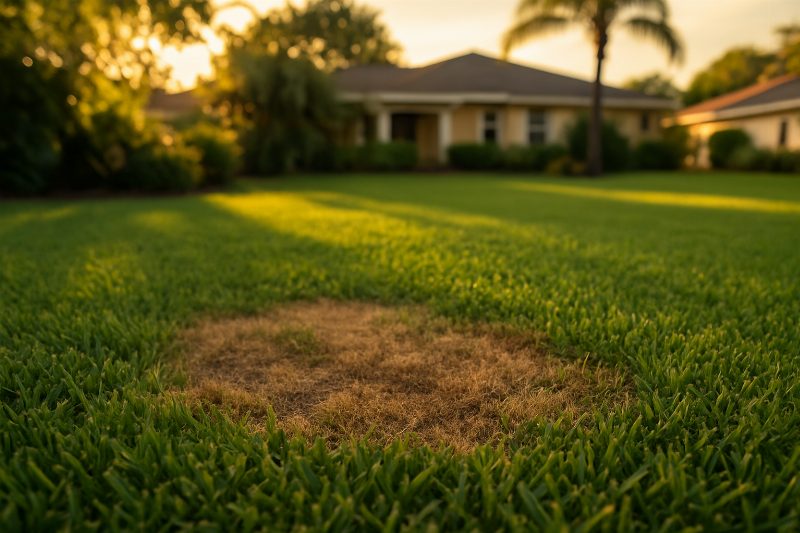
Brown patch fungus does not give you a warning. One morning your St. Augustine lawn looks fine; a week later you are staring at wide, tan circles that look like something scorched the grass from underneath. If you live anywhere from Bradenton to Anna Maria Island, this is one of the most common lawn problems you will face, and it is almost always preventable once you understand what is actually happening at the soil level.
What brown patch fungus actually is
Brown patch is caused by a soil-borne fungus called Rhizoctonia solani. It lives in the thatch layer and upper soil of virtually every lawn in Florida, dormant and harmless until conditions turn in its favor. When they do, the fungus spreads through the grass leaf sheaths and crowns, cutting off the plant's ability to move water and nutrients. The grass does not die from thirst or starvation in the traditional sense; the fungus essentially strangles the individual blades at the base.
What you see above ground is a roughly circular patch of tan or light brown grass, often with a darker, water-soaked-looking ring around the outer edge, especially in the early morning. That darker ring is called the "smoke ring" and it is one of the clearest signs that you are dealing with brown patch rather than drought stress or a pest problem. The circles can range from a foot across to ten or fifteen feet wide, and multiple circles will often merge as the disease progresses.
It is worth noting that brown patch attacks the blades and sheaths, but the crowns and roots usually survive in St. Augustine grass. That matters because it means a properly treated lawn can recover without full resodding, though recovery takes patience.
Why Florida lawns are so vulnerable
The Rhizoctonia fungus needs three things to explode: warm air temperatures, high humidity, and wet leaf surfaces held overnight. Florida delivers all three for a large portion of the year, which is why brown patch is such a persistent problem here compared to lawns in drier climates.
The disease is most active when nighttime temperatures stay above 70°F and daytime temperatures climb into the 80s and 90s. That window describes roughly May through October across Manatee County, with particular intensity during the summer rainy season. Communities like Lakewood Ranch and Parrish, where irrigation systems run on schedules set and forgotten, often see the worst outbreaks because the grass never gets a chance to dry out between waterings.
There are a few other local factors worth understanding:
- Thatch buildup. A thick thatch layer holds moisture right at the soil surface, creating the perfect environment for the fungus to colonize. St. Augustine grass in Florida builds thatch quickly, especially when it receives more nitrogen than it needs.
- Excessive nitrogen fertilization. High-nitrogen fertilizer pushes lush, soft leaf growth that is far more susceptible to fungal infection than firm, moderate growth. Many homeowners fertilize heavily in spring and then wonder why they are fighting brown patch by July.
- Evening watering. Watering at night or in the late afternoon means the grass blades stay wet for eight to twelve hours. That is more than enough time for Rhizoctonia to germinate and penetrate the leaf sheaths.
- Compacted soil. Soil that drains poorly keeps the root zone saturated, which stresses the grass and makes it less able to fight off fungal attack. This is a common issue in older neighborhoods and in areas with heavy clay content.
- Overwatering. Irrigation systems running more than necessary are one of the single biggest contributors to brown patch in this region. Our frequently asked questions page has more detail on recommended watering schedules for Florida lawns.
How to tell brown patch from other problems
Misidentifying the problem leads to the wrong treatment, which wastes money and lets the real issue keep spreading. Brown patch is frequently confused with a handful of other conditions:
Drought stress turns grass a blue-gray color before it browns, and the pattern usually follows sun exposure rather than forming distinct circles. If you walk across drought-stressed grass, your footprints will remain visible for several minutes because the blades cannot spring back. Brown patch does not follow this pattern. For a closer look at this distinction, our post on chinch bugs vs. drought stress in St. Augustine grass walks through the visual cues in detail.
Chinch bugs cause irregular, spreading dead areas that typically start at the edges of the lawn near pavement or concrete, where it is hottest. The damage does not form the clean circles that brown patch produces.
Take-All Root Rot is another fungal disease that looks similar on the surface but destroys the root system rather than just the blades and sheaths. If the grass pulls up easily with almost no resistance and the roots look brown and rotted, you may be dealing with Take-All instead of or in addition to brown patch. Our post on Take-All Root Rot and bare patches that refuse to bounce back covers that disease thoroughly.
Gray leaf spot produces small, grayish lesions on individual blades rather than wide circles, and it tends to appear on newer, recently fertilized grass. If you are seeing spots on the blades rather than entire patches collapsing, read our post on gray leaf spot in St. Augustine grass before reaching for a fungicide.
When in doubt, look for the smoke ring in the early morning. If you can see a dark, wet-looking border around the outer edge of a circular dead area, brown patch is the most likely culprit.
What to do when you find brown patch
Acting quickly limits how far the disease spreads. Here is a practical, step-by-step approach:
1. Stop watering the affected area immediately
The fungus needs wet leaf surfaces to keep spreading. Cut irrigation to the affected zone and let the area dry out as much as possible. If rain is in the forecast every day, focus on the other steps while accepting that weather is outside your control.
2. Adjust your irrigation schedule going forward
Water deeply but infrequently, and always in the early morning so the blades have time to dry before nightfall. The general guideline for St. Augustine in our area is about three-quarters of an inch of water, two to three times per week, depending on the season. Never water after 4:00 p.m.
3. Apply a labeled fungicide
Several fungicides are effective against Rhizoctonia solani, including products containing azoxystrobin, propiconazole, thiophanate-methyl, or myclobutanil. Read the label carefully for the application rate and the recommended interval between applications. Most require two to three applications spaced seven to fourteen days apart to break the disease cycle.
A few practical notes on fungicide application:
- Apply in the early morning or evening to avoid evaporation and to give the product time to absorb before the sun hits.
- Do not mow immediately before or after applying; mowing spreads fungal spores and wounds the grass, making it more susceptible.
- Rotate between two different fungicide classes if you treat the same lawn repeatedly; Rhizoctonia can develop resistance to a single active ingredient over time.
4. Hold off on nitrogen fertilizer
Applying nitrogen fertilizer while the lawn is fighting brown patch is one of the most common mistakes homeowners make. Nitrogen pushes the kind of soft, fast growth that the fungus loves. Wait until the disease has been controlled and the lawn is actively recovering before you fertilize again.
5. Dethatch if buildup is significant
If you can press your fingers into the grass canopy and feel more than half an inch of spongy, cork-like material between the soil surface and the green blades, your thatch is contributing to the problem. Dethatching (or verticutting) removes that moisture-trapping layer and improves air circulation at the soil surface. This is best done in late spring or early summer when the grass is actively growing and can recover quickly.
6. Be patient with recovery
Because brown patch typically leaves the crowns and root system intact in St. Augustine grass, the lawn should begin putting out new green growth within two to four weeks after the disease is controlled and conditions improve. The affected areas will fill in from the edges as stolons creep back across the damaged zone. Larger patches may take a full growing season to completely recover.
If a patch does not show any sign of recovery after six to eight weeks of warm weather and proper care, consider whether another disease or pest is at work. Mole crickets and nutsedge are two additional problems that can complicate recovery in our area.
Preventing brown patch before it starts
Prevention is genuinely easier than treatment, and most of it comes down to a few consistent habits:
- Water in the morning. This single change eliminates the prolonged leaf wetness that the fungus depends on.
- Fertilize conservatively and on the right schedule. In Florida, slow-release fertilizers applied during the active growing season produce steadier, firmer growth than heavy applications of quick-release nitrogen. Avoid fertilizing in the hottest, wettest weeks of summer.
- Mow at the right height. St. Augustine should be kept at three to four inches. Scalping the lawn stresses it; letting it grow too tall traps moisture.
- Improve drainage where you can. Low spots that hold water after rain are chronic brown patch hotspots. Topdressing with sand or regrading problem areas makes a meaningful difference.
- Consider a preventive fungicide application. If your lawn has had brown patch before, a single preventive application of a systemic fungicide in late spring, before symptoms appear, can break the cycle.
Homeowners across Ellenton, Palmetto, and other parts of Manatee County who follow these practices consistently deal with far less disease pressure each summer than neighbors who irrigate on a fixed schedule and fertilize heavily in the spring.
When to call a professional
Sometimes brown patch is a one-time problem corrected with a fungicide and a few schedule adjustments. Other times it keeps coming back season after season despite the homeowner's best efforts, which usually points to an underlying issue: poor drainage, a compacted soil profile, a thatch layer that keeps rebuilding, or an irrigation system that is not calibrated to actual evapotranspiration rates.
If you are seeing recurring outbreaks, or if the disease has spread across a large portion of your lawn, a professional assessment saves time and money compared to trial-and-error treatments. Our team works across Bradenton, Lakewood Ranch, Palmetto, Parrish, Ellenton, and Anna Maria Island, and we are familiar with the specific soil types, drainage patterns, and irrigation habits that tend to drive disease pressure in each area.
You can learn more about our approach on our lawn care and landscaping services page, or get in touch with us directly if you would like us to take a look at what is happening in your lawn. We would rather help you understand the root cause than sell you a recurring treatment you do not need.
Brown patch fungus is common, but it is not inevitable. With the right habits in place and a little knowledge of how the disease works, most Florida homeowners can keep their lawns healthy and green through even the wettest summer we throw at them.