
Watering Your Florida Lawn the Right Way Through a Humid
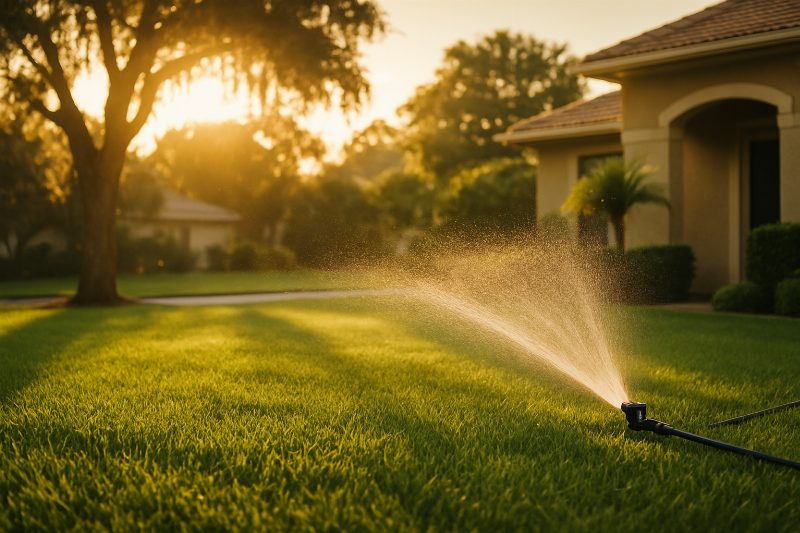
Florida summer rain lies to you. It rolls in every afternoon, dumps half an inch on your yard, and then disappears before the pavement even dries. The temptation is to let the irrigation system keep running on its schedule, because surely more water is better in this heat. It isn't, and that single mistake accounts for more dead and struggling lawns across Bradenton, Lakewood Ranch, and Palmetto than almost any other cause.
Getting your watering right through the humid months of June, July, August, and September isn't complicated, but it does require understanding a few things about how Florida turf actually works, how our local soil behaves, and why the rules you might follow up north simply don't apply here.
Why Humidity Changes the Math
In a dry climate, irrigation is straightforward: the soil dries out, you add water, the grass recovers. In a humid Florida summer, the equation is messier. High relative humidity slows the rate at which water evaporates from the soil surface and from the leaf blades themselves. That means the top inch or two of soil can feel moist for a surprisingly long time after rain, even when the deeper root zone hasn't seen a drop.
St. Augustine grass, which covers the vast majority of lawns in Manatee County, is a relatively deep-rooted turf when healthy. When you water too frequently and too shallowly, those roots have no reason to push downward. They stay near the surface, where soil temperatures swing wildly and where pests and disease find them easiest to attack. You end up with a lawn that looks okay on the surface but is genuinely fragile underneath.
Add daily summer thunderstorms to that picture, and it's easy to see why overwatering is the dominant summer mistake rather than underwatering.
The One-Inch-Per-Week Target (And What It Really Means)
The standard guidance from the University of Florida is that St. Augustine grass needs roughly three-quarters to one inch of water per week during active growing season, combining rainfall and irrigation. The key word is "combining." Your irrigation system should be making up what rainfall doesn't provide, not running on top of it.
That means you need two things: a rain gauge (a cheap plastic one from any hardware store works fine) and a working rain sensor on your irrigation controller. Florida law actually requires rain sensors on all automatic irrigation systems, though plenty of older systems have sensors that have stopped functioning. Check yours. If the system still runs during or right after a rainstorm, the sensor isn't doing its job.
Place a couple of tuna cans or flat containers in different zones of your yard and run each irrigation zone for its usual cycle. Measure how much water collects. This is your application rate per zone, and it tells you exactly how long to run each zone to deliver half an inch or a quarter inch when rainfall falls short.
How to Read Your Lawn, Not Just the Calendar
Your lawn will tell you when it genuinely needs water. St. Augustine grass shows drought stress in a distinctive way: the leaf blades fold lengthwise along the midrib, giving the turf a grayish or blue-green cast instead of its normal bright green. Footprints linger in the grass rather than bouncing back within a few minutes. If you see these signs, it's time to water, regardless of what day of the week it is.
If you don't see those signs, and if your rain gauge shows that the yard received meaningful rainfall in the past few days, hold off. Running irrigation on stressed, wet, heavily clouded soil during a humid week is a fast path to fungal disease.
Speaking of disease: gray leaf spot thrives in exactly the conditions that overwatering creates. If you've noticed tan or gray lesions spreading across your St. Augustine blades during the summer months, learn more in our post on Gray Leaf Spot: The Summer Fungus That Loves St. Augustine Grass. Fungal diseases and excess irrigation tend to escalate together, and breaking the watering cycle is often the first step in getting them under control.
Timing Your Irrigation: Morning, Not Evening
If you water in the evening, stop. Evening irrigation leaves leaf blades wet overnight, when temperatures drop and air circulation is low. That's the exact environment that fungal spores need to germinate. Morning watering, ideally between 4 a.m. and 8 a.m., gives the grass time to dry out completely during the heat of the day while still delivering water before the hottest hours.
Midday irrigation is wasteful because evaporation rates are highest, but it isn't nearly as damaging as evening watering. If you have to choose between watering at noon and watering at 7 p.m., noon is the better call.
Set your irrigation controller to run in the early morning hours and resist the urge to run it manually in the evening just because the lawn looked a little stressed during the afternoon. St. Augustine grass wilts dramatically in afternoon heat as a normal physiological response to limit water loss; it typically recovers as temperatures drop in the early evening without any additional irrigation at all.
Watering Rules in Manatee and Sarasota Counties
Manatee County falls under Southwest Florida Water Management District (SWFWMD) restrictions. During the summer months, most residential properties are restricted to two days per week of lawn irrigation, with specific days determined by your address (odd or even street number). Even when rainfall is abundant, the schedule applies, and you should be respecting it.
More practically, the two-day-per-week schedule is nearly always sufficient during Florida summers when you're applying the right amount of water on those days. Divide your target weekly amount between your two allowed days and program your controller accordingly. If a good afternoon storm delivers half an inch on one of your scheduled days, skip that day's cycle manually or rely on your rain sensor to do it automatically.
If you're not sure whether your irrigation setup is dialed in correctly, or if you'd like a professional eye on your system and your grass, our lawn care and landscaping services include irrigation evaluations that take the guesswork out of it.
Sandy Soil, Clay Pockets, and the Anna Maria Island Challenge
One thing that varies a lot across our service area is soil composition. Much of Bradenton and Parrish sits on very sandy, well-draining soil that can let water pass right through the root zone before the grass can use it. Anna Maria Island adds salt-air exposure and sandy fill soil that drains extremely fast. Homes in parts of Lakewood Ranch and Ellenton sometimes have denser soil with clay pockets that hold moisture far longer than sandy ground does.
For sandy soil, shorter and more frequent irrigation cycles (within your two-day-per-week allowance) can help. Running a zone for two or three cycles of five minutes each, with a 30-minute gap in between, lets water soak in gradually rather than rushing past the roots. This technique is called cycle-and-soak, and it makes a meaningful difference on fast-draining ground.
For heavier soils or low-lying areas that collect runoff, you may need even less irrigation than you think. Standing water or consistently saturated soil creates anaerobic conditions at the root level that damage roots just as surely as drought does. If your lawn has low spots that stay wet, improving drainage or adjusting irrigation run times for those zones is worth prioritizing.
Homeowners on Anna Maria Island also deal with salt spray from Gulf breezes, which can stress turf and make it look like it needs extra water when what it actually needs is a freshwater rinse on the leaf blades rather than more soil moisture.
Common Summer Watering Mistakes
Let's be direct about the specific habits that cause the most trouble during Florida summers:
- Running irrigation on a fixed schedule without accounting for rainfall. If it rained Tuesday, skip Wednesday's cycle.
- Watering every day in small amounts. Frequent shallow watering encourages shallow roots and invites fungal disease.
- Watering in the late afternoon or evening. Wet blades overnight is one of the most reliable ways to end up with a fungal outbreak.
- Ignoring irrigation head coverage. A head that's tilted, clogged, or blocked by overgrown shrubs leaves dry patches that look exactly like disease or pest damage. Walk your zones while they run at least once a month.
- Applying more water when the lawn looks bad without first diagnosing why it looks bad. Not every patchy or discolored lawn is thirsty. Chinch bug damage, take-all root rot, and mole cricket tunneling all look like drought stress. More water often makes those problems worse. Our guides on chinch bugs vs. drought stress and Take-All Root Rot can help you separate a watering problem from a pest or disease problem before you react.
What Healthy Summer Watering Looks Like in Practice
Here's a practical routine that works well across most of our service area, from Palmetto to Parrish:
- Check your rain gauge after every significant storm. Anything under a quarter inch doesn't meaningfully count toward your weekly total.
- Skip your next scheduled irrigation day if rainfall delivered half an inch or more in the past few days.
- Run your system between 4 and 8 a.m. on your two allowed days, delivering approximately three-eighths to half an inch per session.
- Walk your zones monthly to confirm every head is functioning, aimed correctly, and not blocked.
- Look for stress signs (folding blades, blue-green tint, slow footprint recovery) before adding any extra water.
- If you see disease or pest symptoms, diagnose before irrigating more. Adding water to a fungal outbreak or a chinch bug infestation accelerates the damage.
If you want to dig deeper into other summer turf threats that often get misread as watering issues, our post on mole crickets is a good next read, as is our article on nutsedge control, since that persistent weed loves waterlogged conditions.
When to Call in a Professional
Some irrigation problems aren't fixable with a schedule tweak. If your system has zones with inconsistent coverage, broken heads, a malfunctioning rain sensor, or a controller that won't hold programming, those mechanical issues undermine every best practice you try to follow. The same is true if your lawn has developed persistent disease or pest pressure that repeated watering adjustments haven't resolved.
Our team serves homeowners across Bradenton, Lakewood Ranch, Ellenton, and the rest of Manatee County with exactly this kind of problem-solving. You can read more about how we work and what we stand for on our about page, or reach out directly through our contact page to talk through what's going on with your lawn.
Getting the water right is unglamorous work, but it's the foundation everything else rests on. A lawn that's watered correctly through the summer stays dense, resists disease and pests far better, and looks dramatically better come fall than one that was either parched or drowning. The good news is that the adjustments are usually small once you understand the logic behind them.