
Land grading vs. French drains: which fix is right
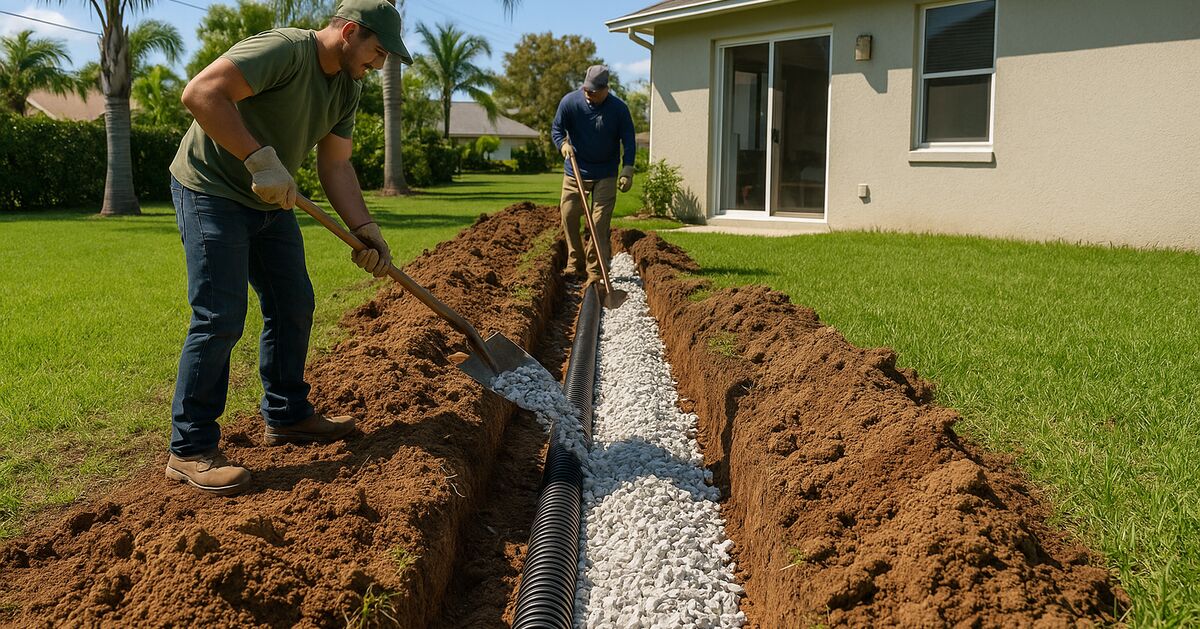
Pooling water can kill your grass, rot your fence posts, and send moisture creeping toward your foundation - and in Bradenton, Parrish, and the rest of Manatee County, it happens fast because the soil is often sandy on top and sits over a dense layer that slows percolation to a crawl. Before you spend a dollar on a fix, you need to diagnose why water is staying put, because land grading and French drains solve fundamentally different problems. Choosing the wrong one is a common and expensive mistake.
Why drainage problems are especially common here
Southwest Florida typically gets heavy seasonal rainfall, with most of it falling between June and September in short, violent bursts. A single summer storm can drop two or three inches on Manatee County in under an hour, according to local weather patterns. Most drainage systems, including the ones that were installed when your neighborhood was built, were designed for that load - but only when they are functioning as designed.
Problems multiply when:
- Soil settles over time and low spots develop near foundations or fence lines
- Neighboring construction changes how sheet flow moves across the block
- Lawn edging, landscaping beds, or hardscaping create unintended dams
- Irrigation adds moisture on top of already-saturated ground (see why your sprinkler system may be wasting water)
- Tree roots heave the grade in subtle ways
In communities like Lakewood Ranch and Parrish, where lots were mass-graded to minimum code during development, even small soil settlement can flip a yard from draining well to holding two or three inches of standing water after a rain event. Anna Maria Island homeowners face a related but different challenge: the water table is high, the soil is almost pure sand, and proximity to the Gulf means tidal influence can raise groundwater to within a few feet of the surface during king tides.
What land grading actually does
Grading - sometimes called re-grading or resloping - physically reshapes the soil so water moves in the direction you want it to go. The goal is positive drainage, generally recommended as at least six inches of fall over the first ten feet from the foundation. The water then sheet-flows toward the street, an existing swale, or a designated drainage easement.
Grading is the right answer when:
- Water pools because the yard is flat or slopes toward the house
- There is no obstruction stopping water from reaching the street or a storm inlet - it just has nowhere to flow naturally
- The low spot is shallow and covers a large area (say, a wide, shallow bowl in the back yard)
- The fix can be accomplished by moving existing soil, adding fill, or both, without burying water anywhere
The work typically involves a laser transit or grade rod to establish existing elevations, then a skid steer or hand grading to reshape the terrain. In tighter residential lots in Ellenton or Palmetto, most of the work is done with hand tools around existing landscaping. When done correctly, re-grading is a permanent fix because water simply has no choice but to run toward the outlet.
Where grading falls short:
Re-grading works only when there is somewhere for the water to go once you redirect it. If your lot is surrounded by other lots at the same elevation, the street is higher than your yard, or the water table is near the surface (a reality for many Anna Maria Island and waterfront Bradenton properties), tilting the surface does not help much. You cannot grade water uphill, and you cannot grade your way out of a high water table.
What a French drain actually does
A French drain moves water underground. The classic installation involves a trench, a perforated pipe wrapped in filter fabric, surrounded by clean gravel, and buried below grade. Water enters the system either through the perforations in the pipe (collecting subsurface water that is moving laterally through the soil) or through a catch basin or surface inlet (collecting water that pools on top). It then travels through the pipe by gravity to a daylight outlet - ideally a swale, retention area, or storm system.
A French drain is the right answer when:
- Water pools in a clearly defined low spot that has no practical grading outlet
- The source of the problem is subsurface: a perched water table or lateral seepage from a neighbor's higher yard
- You have a hardscaped area (patio, driveway, pool deck) that cannot be regraded because it is fixed in place
- The outlet is available at a lower elevation - typically 18 to 36 inches below the surface at the inlet end
A well-designed French drain on a Lakewood Ranch or Parrish lot will have the inlet at the low point where water collects, a pipe with a consistent fall of at least one percent (one inch of drop for every eight feet of run), clean washed gravel (typically pea gravel or #57 stone) surrounding the pipe, and a filter fabric sleeve to keep fines from clogging the system over time. The outlet should daylight in a swale or discharge through a pop-up emitter that closes when not flowing.
Where French drains fall short:
A French drain is only as good as its outlet. If the pipe has nowhere to empty, water simply backs up and the drain stops functioning. In very flat neighborhoods, finding a legal outlet can be the hardest part of the design. Florida law (codified in the Florida Statutes, Chapter 298, governing water control districts) generally prohibits discharging drainage water onto a neighbor's property without their consent, and local municipalities including Manatee County may require permits for drainage work that connects to public systems. Always confirm outlet legality before you dig.
French drains also require periodic maintenance. The fabric and gravel can slowly clog with organic material and fine particles - a process that accelerates in yards with heavy leaf drop from oaks or palms. A drain that works perfectly for five years can begin to back up and fail without visible warning.
The side-by-side comparison
| Factor | Land Grading | French Drain | |---|---|---| | Best problem | Surface flow in wrong direction | Standing water with no outlet | | Works without an outlet? | Yes, if water can sheet-flow to street/swale | No - a gravity outlet is essential | | Effective on high water table? | Rarely | Only somewhat | | Hardscaped areas? | Not an option | Good fit | | Maintenance needed? | Minimal | Yes - inspect annually | | Disturbs landscaping? | Significant | Moderate (trench only) | | Typical lifespan | Permanent if soil is stable | 10-20+ years with maintenance |
When you need both
A mistake that comes up again and again in contractor discussions and homeowner forums is treating these two systems as mutually exclusive. On many lots, particularly in Bradenton's older established neighborhoods, the right answer is a combination: re-grade the yard so the surface drains toward a defined low point, install a catch basin at that low point, and connect it to a French drain pipe that daylights in the front swale or street curb. Each system does what it is good at, and neither is asked to do the job of the other.
This combined approach is also the standard fix when water is backing up toward a slab foundation. The University of Florida IFAS Extension recommends maintaining positive drainage away from all structures as the first line of defense against moisture intrusion, and their guidance consistently pairs surface grading with subsurface management when soil conditions warrant both.
Permits and local rules you need to know
Manatee County's Development Services department may require permits for drainage work that alters stormwater flow or connects to public infrastructure, so check with them before starting. Even on a residential lot, if you are installing a pipe that outlets into a county swale or storm inlet, you will typically need an erosion and sediment control plan and a right-of-way permit. SWFWMD (the Southwest Florida Water Management District) also has jurisdiction over any project that meets certain thresholds for earthwork or impervious surface. The takeaway: talk to Manatee County Development Services before significant grading or drain installation, not after.
For reference, SWFWMD's Environmental Resource Permitting (ERP) rules govern projects that disturb over one acre, but local municipalities can and do impose stricter thresholds on smaller work. Some HOAs in Lakewood Ranch and Parrish have their own drainage standards layered on top of county rules.
How to diagnose your own yard before calling anyone
Before you invite quotes, spend fifteen minutes after the next heavy rain with your phone camera. Walk the property and note:
- Where water ponds - and approximately how many square feet and how many inches deep
- How long it stays - less than four hours is often acceptable on sandy Florida soil; longer suggests a real problem
- Which direction the surface slopes - you can check with a simple line level or even a marble rolled on the ground
- Whether the water is coming from your own irrigation or rain, or from an adjacent property - neighbor runoff changes the legal and engineering picture
- Where the nearest swale, inlet, or street curb is and whether it is higher or lower than the problem area
Bring those photos and observations when you talk to a contractor. A good drainage professional will want to see actual conditions, not just a dry yard on a sunny day. Our team at Manatee Lawn Care handles drainage assessments alongside our regular lawn care and landscaping work, so we can look at grading, soil health, and irrigation all at once rather than treating each in isolation.
Soil type matters more than homeowners expect
Sandy soils common in coastal Bradenton and Anna Maria Island drain quickly on their own - the problem there is usually grade (water going the wrong way) or a high water table, not soil permeability. Heavier, silty soils found in some inland Parrish and Ellenton neighborhoods drain more slowly and can stay saturated for days after a heavy rain even when the grade is correct. Understanding your soil type tells you which fix to prioritize.
If you are not sure what your soil is doing, a soil test can reveal not just nutrients but also texture and organic matter content. Our post on how to read a soil test and fix your Manatee County lawn walks you through the process from collecting a sample to interpreting the lab report.
Compacted soils are a third category. Heavily trafficked areas, particularly around gates, play areas, and the edges of driveways, can become so compacted that water sits on top even when the grade is technically correct. Core aeration is often the cheapest fix in those cases, and it pays dividends for grass health as well.
What to expect from the installation process
A re-grading job on a typical residential lot (roughly 6,000 to 10,000 square feet) in Manatee County usually takes one to two days for the earthwork plus time for sod repair. The disturbed area will need re-sodding or at minimum re-seeding, and the new grade needs to settle before you can be confident it is holding. Irrigation heads often need to be raised or reset after grading.
A French drain installation on a similar lot - inlet, 50 to 100 linear feet of pipe, gravel, and outlet - can typically be completed in one day. Sod over the trench will take two to four weeks to re-knit fully. The drain should be flushed with a garden hose immediately after installation to confirm flow, and again after the first significant rain event.
In either case, the fix needs to be evaluated over a full rainy season (June through September) before you can declare success. Minor adjustments are normal.
Getting the right help
Drainage is one of those yard problems where a wrong guess is worse than no action. Re-grading toward a low outlet that does not exist just moves your pond to a new location. A French drain without a proper outlet backs up within a year. And neither fix addresses the problem if the real culprit is an irrigation controller running too many days per week - which is a separate but related issue worth reviewing with SWFWMD's current watering restrictions.
We serve homeowners across Bradenton, Lakewood Ranch, Palmetto, Parrish, Ellenton, and Anna Maria Island, and drainage assessments are part of how we approach the full picture of a yard's health. If you have questions about your specific situation, our FAQ page covers a range of common drainage and lawn care questions, or you can reach us directly through our contact page to talk through what is happening in your yard.
The bottom line: match the fix to the actual cause. Grading for slope problems, French drains for low spots with nowhere to go, and sometimes both working together. Get the diagnosis right first, and the solution becomes straightforward.
Sources & further reading
- UF/IFAS Extension - Home Drainage and Grading Guidance (University of Florida IFAS Extension)
- SWFWMD Environmental Resource Permitting (ERP) Program (Southwest Florida Water Management District (SWFWMD))
- Florida Statutes Chapter 298 - Water Control Districts (Florida Legislature)
Claim-by-claim audit (8 checked)
- “Southwest Florida typically gets heavy seasonal rainfall, with most of it falling between June and September in short, violent bursts.” (rewritten to what the article can stand behind)
- “A single summer storm can drop two or three inches on Manatee County in under an hour, according to local weather patterns.” (rewritten to what the article can stand behind)
- “The goal is positive drainage, generally recommended as at least six inches of fall over the first ten feet from the foundation.” (rewritten to what the article can stand behind)
- “Florida law (codified in the Florida Statutes, Chapter 298, governing water control districts) generally prohibits discharging drainage water onto a neighbor's property without the…” (cited → flsenate.gov)
- “The University of Florida IFAS Extension recommends maintaining positive drainage away from all structures as the first line of defense against moisture intrusion, and their guidan…” (cited → edis.ifas.ufl.edu)
- “Manatee County's Development Services department may require permits for drainage work that alters stormwater flow or connects to public infrastructure, so check with them before s…” (rewritten to what the article can stand behind)
- “SWFWMD (the Southwest Florida Water Management District) also has jurisdiction over any project that meets certain thresholds for earthwork or impervious surface.” (cited → swfwmd.state.fl.us)
- “For reference, SWFWMD's Environmental Resource Permitting (ERP) rules govern projects that disturb over one acre, but local municipalities can and do impose stricter thresholds on …” (cited → swfwmd.state.fl.us)